Guru Purnima
Vyasa (Guru)
When it falls
The date shifts because it tracks the moon, not the Gregorian calendar.
Calculated for India (IST) using precise Panchang astronomy. Dates can shift by a day at locations far to the east or west.
Why Guru Purnima Matters
Guru Purnima falls on the full moon (purnima) of the Hindu month of Ashadha, usually in June or July. The word guru is traditionally read as one who leads a person from darkness to light — in practice, anyone who passes on real knowledge, whether a spiritual teacher, a scholar, or the schoolteacher who first taught you to read. The day is set aside to acknowledge that debt openly.
The festival is also called Vyasa Purnima, after the sage Veda Vyasa, who is traditionally credited with arranging the Vedas into four collections and composing the Mahabharata and the Puranas. Because he organised this large body of learning into a form later generations could study, the tradition remembers him as a foremost teacher, and his birth is marked on this day.
For monks and many ascetics, Guru Purnima opens Chaturmas — roughly four months of the rainy season spent in one place rather than wandering. The full moon was a practical marker: with travel difficult during the monsoon, teachers settled in one place and students gathered around them, making this the start of a season of sustained study.
Rituals & observance
Observances on Guru Purnima are simple and centre on the relationship between teacher and student. There is no single prescribed rite — what people do depends on their tradition and their teacher.
- Visit your guru or teacher, offer respect (often by touching their feet), and present flowers, fruit, or sweets as a token of gratitude.
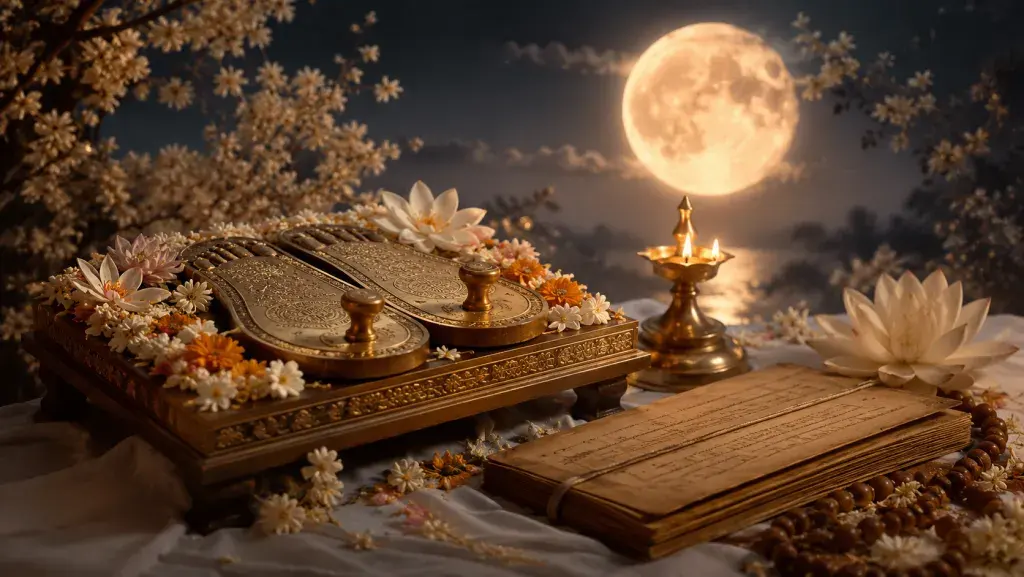
- In ashrams and homes, devotees perform Guru Puja — honouring the teacher's seat or sandals (paduka) and the lineage of teachers before them.
- Many use the day to renew their study, taking a vow to read scripture, learn a new practice, or restart something a teacher once set in motion.
- Some observe a fast through the day and break it after the evening puja or at moonrise.
- Spiritual organisations hold gatherings (satsang) and discourses, and followers may receive a mantra or initiation (diksha) on this day.
- Charity and feeding others — particularly offering food to teachers, students, or those in need — is considered fitting for the occasion.
Regional variations
How this date is determined
Observed on the full-moon day (Purnima) of Ashadha (Shukla paksha), reckoned by sunrise (udaya tithi).
Dates are computed to astronomical precision (NASA/JPL ephemeris), in line with traditional panchang.