Sharad Purnima
Goddess Lakshmi, Lord Krishna
When it falls
The date shifts because it tracks the moon, not the Gregorian calendar.
Calculated for India (IST) using precise Panchang astronomy. Dates can shift by a day at locations far to the east or west.
Why Sharad Purnima Matters
Sharad Purnima falls on the full moon (purnima) of the Hindu month of Ashwin, usually in September or October. It marks the close of the monsoon and the start of the clear autumn season (sharad), when the sky is finally free of cloud. By tradition the moon on this night shines with all sixteen of its phases (kalas) complete, which is why it is remembered as the brightest and most beautiful full moon of the year. The festival comes soon after Navratri and Dussehra and about three weeks before Diwali.
The night is dedicated to Goddess Lakshmi, the deity of wealth and wellbeing. A widely told belief holds that on this night Lakshmi moves through the world asking Ko jagarti? — "Who is awake?" — and blesses the households she finds keeping vigil rather than asleep. This is the origin of the festival's other common name, Kojagari Purnima (literally, "who is awake"), and of the custom of staying up through the night in her honour.
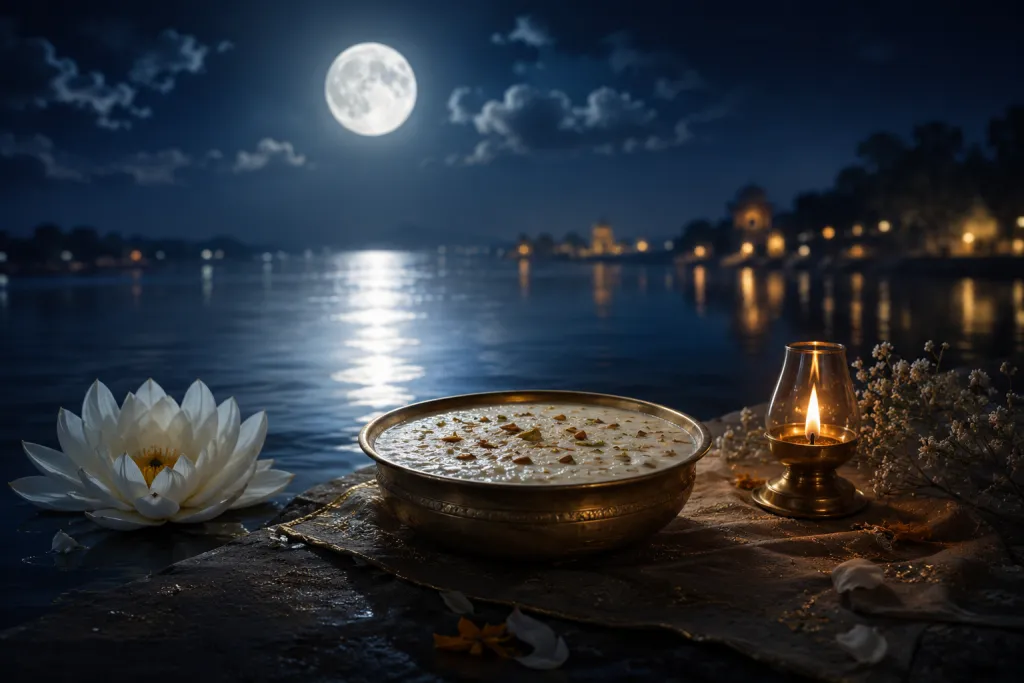
A second strand of meaning comes from the Krishna tradition, where this full moon is linked to the Raas Leela — the night Krishna is said to have danced with the gopis of Vrindavan. The moonlight itself is treated as significant: many believe the rays on this one night carry a cooling, restorative quality, which is the reasoning behind the well-known practice of leaving food out to absorb them.
Rituals & observance
Observance centres on the full moon and the night vigil. Customs differ by region and family, but a few practices are common almost everywhere the festival is kept.
- Kheer in the moonlight: families prepare kheer (sweet rice cooked in milk) and place it outdoors under the open moon for several hours, often overnight, so it takes in the moonlight; it is then offered to the deity and eaten as prasad, usually the next morning.
- Lakshmi puja in the evening: the goddess is worshipped after moonrise with lamps, incense, flowers, and offerings, with prayers for prosperity and the welfare of the household.
- Night vigil (jagran): many stay awake through the night singing devotional songs (bhajan and kirtan), playing games, or simply spending time together, in keeping with the belief that Lakshmi blesses those who are awake.
- Sitting in the moonlight: people sit out under the full moon for part of the night, a custom tied to the traditional view that the night's rays are calming and good for the body and mind.
- Some keep a daytime fast: a number of observers fast through the day and break it at night after the puja, often with the kheer that has been set out under the moon.
- Krishna devotees mark the Raas Leela: in Vrindavan, Mathura, and other Krishna centres, temples hold special worship and night programmes recalling Krishna's dance with the gopis.
Regional variations
How this date is determined
Observed on the full-moon day (Purnima) of Ashwin (Shukla paksha), reckoned by the night-pervading full moon. Should the tithi fall across two days, tradition keeps the day with the greater overlap (adhika-vyapti).
Dates are computed to astronomical precision (NASA/JPL ephemeris), in line with traditional panchang.