Amavasya
Dates in 2026
A monthly observance — here are its dates through this year.
Calculated for India (IST) using precise Panchang astronomy. Dates can shift by a day at locations far to the east or west.
Why Amavasya Matters
Amavasya is the new-moon day — the night the Moon is not visible because it sits between the Earth and the Sun. In the Hindu lunar calendar it marks the end of the dark fortnight (Krishna Paksha) and the close of the lunar month, after which the waxing fortnight begins again. Because it returns once every lunar month, Amavasya is a recurring marker rather than a single annual festival, and most months carry their own name and customs for it.
The day is most strongly associated with the ancestors (pitru). By long tradition, the dark fortnight and especially the new-moon day are considered the right time to remember those who have passed and to perform tarpan — offerings of water, and in many families food and prayers — so that the family's obligation to its forebears is kept up. This is why charity (daan) and feeding others, including priests, animals, and those in need, are common on this day.
Some Amavasyas carry added weight by which lunar month they fall in or which weekday they land on. The Amavasya during the ancestral fortnight is observed as Sarva Pitru Amavasya; the one in the month of Magha is kept as Mauni Amavas, a day of silence and bathing; and the new-moon of Kartik coincides with Diwali. A Monday Amavasya (Somvati) and a Saturday Amavasya (Shani) are also singled out in many regions for their own observances.
Rituals & observance
Amavasya is a day of remembrance and restraint rather than celebration. Customs vary by family and region, but the common threads are honouring ancestors, giving in charity, and keeping the day simple. Typical observances include:
- Ancestral offering (pitru tarpan): offering water, and in many homes food and prayers, to remember departed family members and keep up the family's duty to its ancestors.
- Sacred bath (snan): a bath at home before sunrise, or a dip in a river or holy water body where that is the local custom, taken as a mark of purification.
- Charity (daan): giving food, clothes, or essentials to those in need, and in many families feeding priests, the poor, cows, crows, or other animals.
- A simple, restrained day: many people keep a light or fasting routine, avoid starting major new ventures, and spend the day in prayer or quiet remembrance.
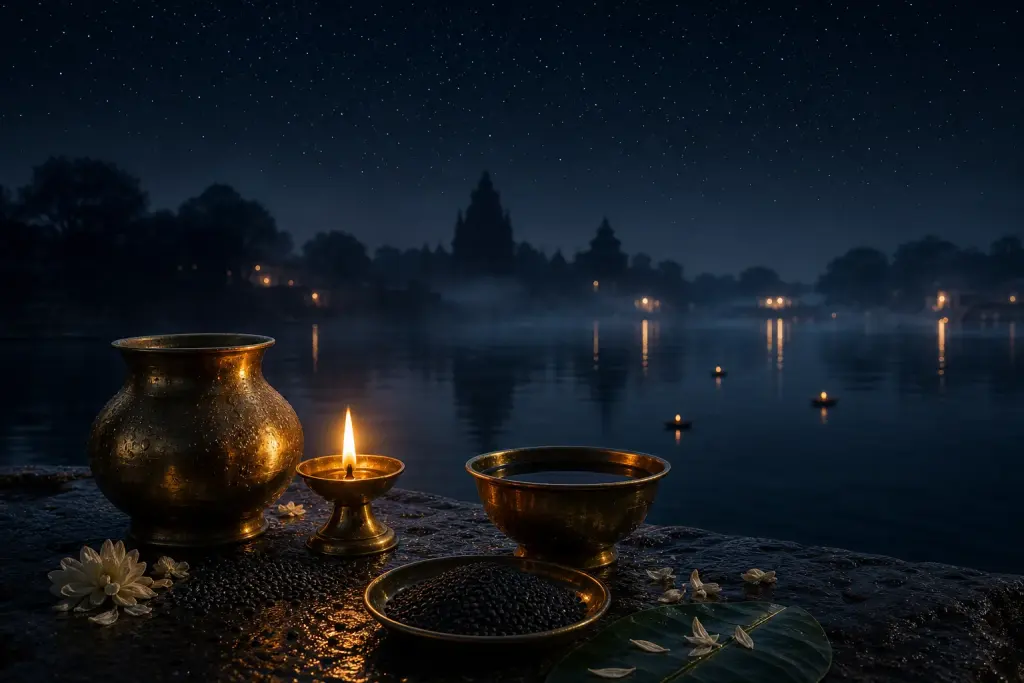
- Lighting a lamp (diya) in the evening, since the night is moonless, and offering prayers to the family deity or to Lord Shiva, who is associated with this day in many traditions.
- Following any month-specific custom — for example silence and river-bathing on Mauni Amavas, or full ancestral rites on the Amavasya during the ancestral fortnight.
How this date is determined
Observed on the new-moon day (Amavasya), reckoned by the afternoon (aparahna).
Dates are computed to astronomical precision (NASA/JPL ephemeris), in line with traditional panchang.