Mauni Amavas
When it falls
The date shifts because it tracks the moon, not the Gregorian calendar.
Calculated for India (IST) using precise Panchang astronomy. Dates can shift by a day at locations far to the east or west.
Significance & meaning
Mauni Amavas is the Amavasya — the no-moon day — that falls in the month of Magha, in the dark fortnight (Krishna Paksha). The name comes from maun, silence: the day is traditionally kept quietly, with as little idle talk as the household allows, so that the bath, the offerings, and the giving are done with a settled mind rather than in a rush. It is one of the more important new-moon observances of the year, especially across the north.
Like most Amavasya days, it is closely tied to remembrance of the departed. Offerings of water and sesame to ancestors (pitru tarpan) are a central part of the day; the no-moon tithi is held in tradition to be the time when such offerings reach the forefathers most readily. Charity (daan) — food, sesame, blankets, or grain to those in need — usually accompanies the tarpan and is considered as much a part of the observance as the bath itself.
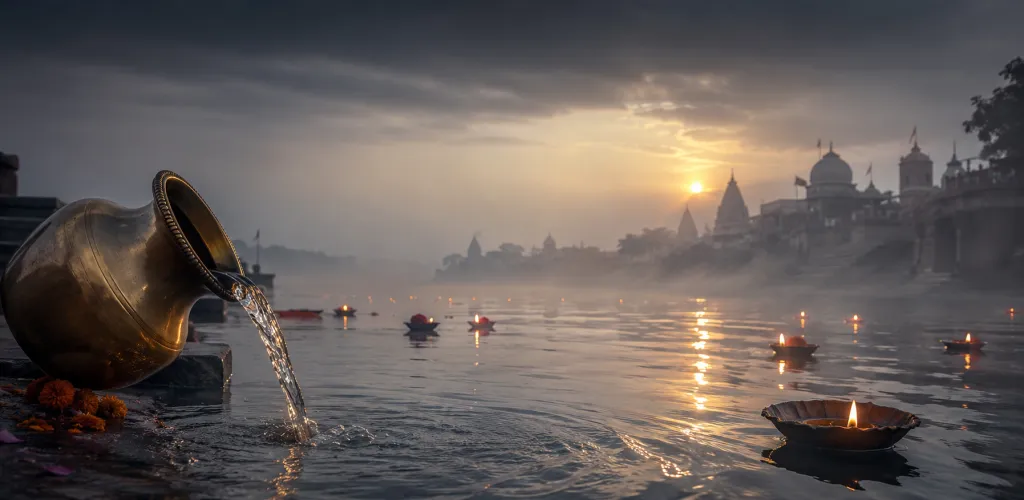
The day carries added weight because it falls during Magha, the month most associated with bathing at sacred rivers (the Magha snan). At the Sangam in Prayagraj — the meeting of the Ganga, Yamuna, and the unseen Saraswati — Mauni Amavas is one of the principal bathing days of the annual Magh Mela, and a major one during the Kumbh. Crowds gather there before dawn for the holy dip, which is why the day is often pictured as a great riverside bath even though it is, at heart, a quiet personal observance that can be kept at any clean water-source or even at home.
Rituals & observance
How Mauni Amavas is kept:
- The central act is the holy bath (snan) taken before or at sunrise — ideally in a sacred river, above all at the Sangam in Prayagraj, but a dip in any river, or a simple bath at home with a little Ganga water added, serves where travel is not possible.
- Many keep a vow of silence (maun vrat) for part or all of the day — at minimum, avoiding gossip and argument and doing the bath and offerings without idle chatter.
- Offerings to ancestors (pitru tarpan) are made with water and black sesame seeds, in remembrance of the departed of the family; many also offer water (arghya) to the rising Sun.
- Charity (daan) is given through the morning — food, sesame, grain, warm clothing, or blankets to the poor — and is treated as inseparable from the bath and the offerings.
- The day is spent simply — light or fasting food, restrained speech, and time given to prayer, japa, or quiet sitting rather than to busy errands.
Regional variations
How this date is determined
Observed on the new-moon day (Amavasya) of Magha (Krishna paksha), reckoned by sunrise (udaya tithi).
Dates are computed to astronomical precision (NASA/JPL ephemeris), in line with traditional panchang.