Vivah Panchami
Lord Rama, Goddess Sita
When it falls
The date shifts because it tracks the moon, not the Gregorian calendar.
Calculated for India (IST) using precise Panchang astronomy. Dates can shift by a day at locations far to the east or west.
Significance & story
Vivah Panchami remembers the marriage of Rama, the prince of Ayodhya, to Sita, the daughter of King Janaka of Mithila. The Ramayana tells it as the moment Rama lifted and strung the great bow of Shiva that no other suitor could move, winning Sita's hand. The day is held to be the anniversary of that wedding, which is why the central observance is not a birth or a victory but a marriage re-enacted in full.
Where Ram Navami honours Rama's birth, Vivah Panchami honours the union that the tradition treats as a model of an ideal couple. The story is read less for its romance than for the conduct it shows — Sita's steadiness and Rama's adherence to his word, the same qualities that carry through the harder chapters of their life together. Temples and households mark the day by performing the deities' wedding rather than only retelling it.
The festival belongs most of all to two places: Mithila, Sita's homeland, centred on Janakpur in present-day Nepal, and Ayodhya, Rama's city. In both, the day is the high point of the local religious calendar. In some families, though, Vivah Panchami is deliberately not chosen as a date to marry their own daughters — because Sita's married life, despite its beginning, held exile and long separation, and they would rather not echo it.
Rituals & observance
How Vivah Panchami is kept:
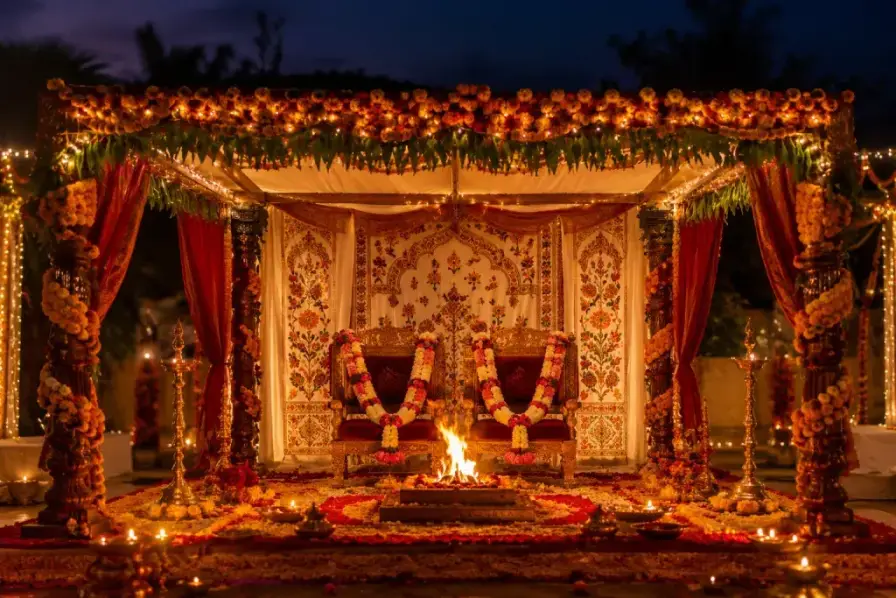
- The central rite is a re-enacted wedding (vivah) of Rama and Sita: temple images of the two are dressed as bride and groom and married with the full sequence of marriage rituals, often through the evening into the night.
- Readings from the Ramayana, especially the Bala Kanda passages on the breaking of Shiva's bow and the wedding, are recited at home and in temples through the day.
- In Janakpur (Mithila), a large fair and procession accompany the marriage, with a groom's party (barat) symbolically arriving from Ayodhya; in Ayodhya, temples along the Sarayu hold special darshan and bhajan.
- Many devotees keep a fast through the day and break it after the evening marriage ceremony is complete.
- Singing of marriage songs and bhajans to Rama and Sita is common, and some households set out a small canopy (mandap) for the deities as they would for a family wedding.
Regional variations
How this date is determined
Observed on the Panchami tithi of Margashirsha (Shukla paksha), reckoned by sunrise (udaya tithi).
Dates are computed to astronomical precision (NASA/JPL ephemeris), in line with traditional panchang.