Vaikuntha Chaturdashi
Lord Vishnu
When it falls
The date shifts because it tracks the moon, not the Gregorian calendar.
Calculated for India (IST) using precise Panchang astronomy. Dates can shift by a day at locations far to the east or west.
What Vaikuntha Chaturdashi means
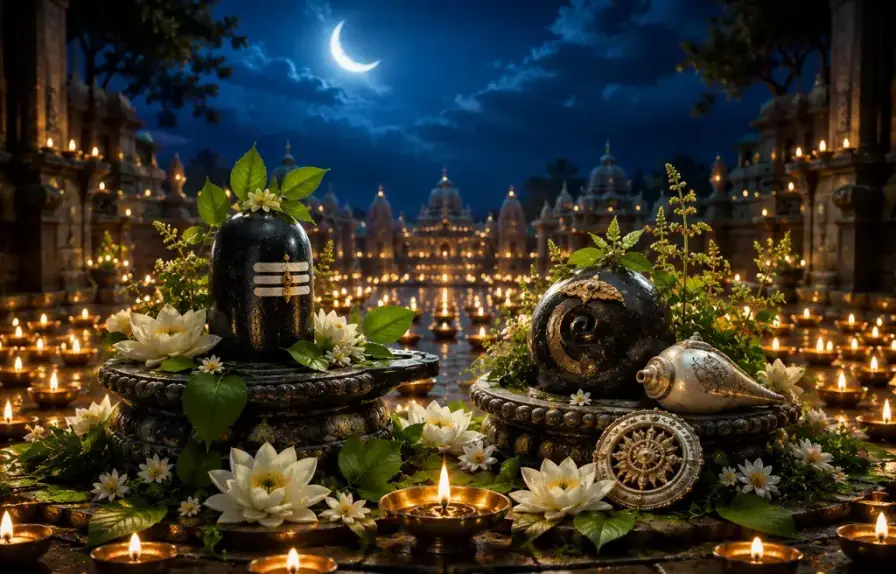
Vaikuntha Chaturdashi is the one day in the year on which Vishnu and Shiva (Hari and Hara) are worshipped together. It falls on Kartik Shukla Chaturdashi, the fourteenth day of the bright fortnight of Kartik, the night before Kartik Purnima, usually in November. Where most observances honour one deity, this day brings the two great traditions together in a single worship, and it is kept as a vrat with the main devotion held at night.
The best-known story explains why the two are joined. By tradition Vishnu worshipped Shiva at Kashi (Varanasi) with a thousand lotus flowers and, finding himself one short, offered his own lotus-like eye in its place. Pleased by this devotion, Shiva granted him the Sudarshana chakra, the discus that became Vishnu's foremost weapon. The episode is read as a meeting of the two paths, and it is why the day's worship deliberately crosses the usual offerings.
On this day the customary offerings are exchanged: bilva (bel) leaves, normally given to Shiva, are offered to Vishnu, and tulsi, normally given to Vishnu, is offered to Shiva. The main worship is kept at night, in the nishita kaal, rather than in daylight. It is observed with special devotion at Kashi, above all at the Manikarnika ghat, and at Rishikesh, and falls just before Dev Diwali on Kartik Purnima, so it opens the close of the sacred month of Kartik.
Rituals & observance
Vaikuntha Chaturdashi is a vrat kept with night worship, joining the devotions of Vishnu and Shiva. The customs centre on the exchanged offerings and the nighttime puja.
- A fast (vrat): devotees keep a fast through the day, completing it after the night worship of Vishnu and Shiva together.
- Worship of Vishnu and Shiva together: the two deities are worshipped side by side, the one day in the year on which Hari and Hara are honoured in a single devotion.
- The exchanged offerings: bilva (bel) leaves, normally offered to Shiva, are given to Vishnu, and tulsi, normally offered to Vishnu, is given to Shiva, marking the joining of the two traditions.
- Night worship in the nishita kaal: the main puja is kept at night, in the nishita kaal, rather than in daylight, with lamps lit before the deities.
- Worship at Kashi and Rishikesh: the day is observed with special devotion at Kashi (Varanasi), above all at the Manikarnika ghat, and at Rishikesh, where large numbers gather for the night worship.
Regional variations
How this date is determined
Observed on the Chaturdashi tithi of Kartik (Shukla paksha), reckoned by sunrise (udaya tithi).
Dates are computed to astronomical precision (NASA/JPL ephemeris), in line with traditional panchang.