Swaminarayan Jayanti
Swaminarayan
When it falls
The date shifts because it tracks the moon, not the Gregorian calendar.
Calculated for India (IST) using precise Panchang astronomy. Dates can shift by a day at locations far to the east or west.
Who he was, and what the day marks
Swaminarayan Jayanti marks the birth of Bhagwan Swaminarayan, who was born in 1781 as Ghanshyam Pande in Chhapaiya, a village near Ayodhya in present-day Uttar Pradesh. As a young ascetic he travelled across India on foot for several years before settling in Gujarat, where he reorganised and led a devotional community that came to be known as the Swaminarayan Sampradaya. His followers within the tradition regard him as a manifestation of God; outside it he is widely respected as a reformer and teacher.
His teachings are gathered chiefly in the Shikshapatri, a set of conduct precepts he wrote, and the Vachanamrut, a record of his spoken discourses. The emphasis is practical: non-violence, honesty, restraint, regular worship, and clear rules of conduct for householders and ascetics alike. Much of his social work — opposing certain ritual excesses, building step-wells and temples, and organising relief during famine — is remembered as part of why the day is kept, not only the birth itself.
Because the tradition places his birth on Chaitra Shukla Navami, Swaminarayan Jayanti falls on the same lunar day as the birth of Rama. For Swaminarayan followers the two are observed together rather than in competition — many temples mark Ram Navami in the morning and the appearance of Swaminarayan around midday, since both births are traditionally placed at noon.
Rituals & observance
How Swaminarayan Jayanti is kept:
- Many devotees keep a day-long fast (upvas), taking only fruit or a single simple meal, and break it after the midday celebration.
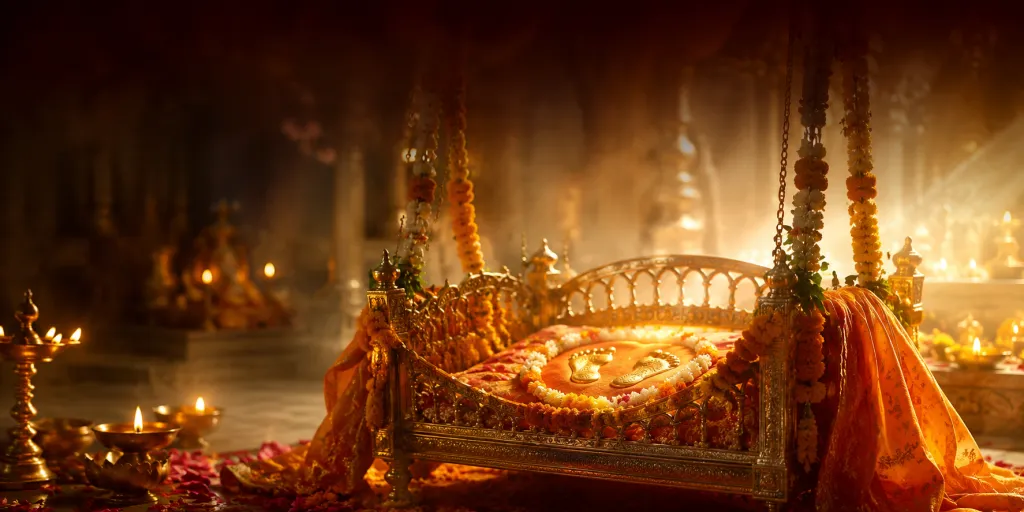
- The high point is the midday birth celebration, since the tradition places the birth at noon. In temples an image or cradle of the infant Ghanshyam is set out, decorated, and rocked, with conch, bells, and singing at the moment of birth.
- Temples hold kirtan and bhajan through the day, along with readings from the Shikshapatri and Vachanamrut, his core writings.
- Larger temples — including the well-known BAPS Swaminarayan Mandirs and other Swaminarayan organisations — hold special darshan, aarti, and discourses (katha) recounting his life and travels.
- Devotees commonly visit the mandir for darshan, offer prasad, and take part in or donate toward community service and food distribution, reflecting the tradition's stress on seva.
- In many Gujarati households the day is observed at home with worship before the family shrine and a festive meal once the fast is broken.
Regional variations
How this date is determined
Observed on the Navami tithi of Chaitra (Shukla paksha), reckoned by sunrise (udaya tithi).
Dates are computed to astronomical precision (NASA/JPL ephemeris), in line with traditional panchang.