Sita Navami
Goddess Sita
When it falls
The date shifts because it tracks the moon, not the Gregorian calendar.
Calculated for India (IST) using precise Panchang astronomy. Dates can shift by a day at locations far to the east or west.
Significance & story
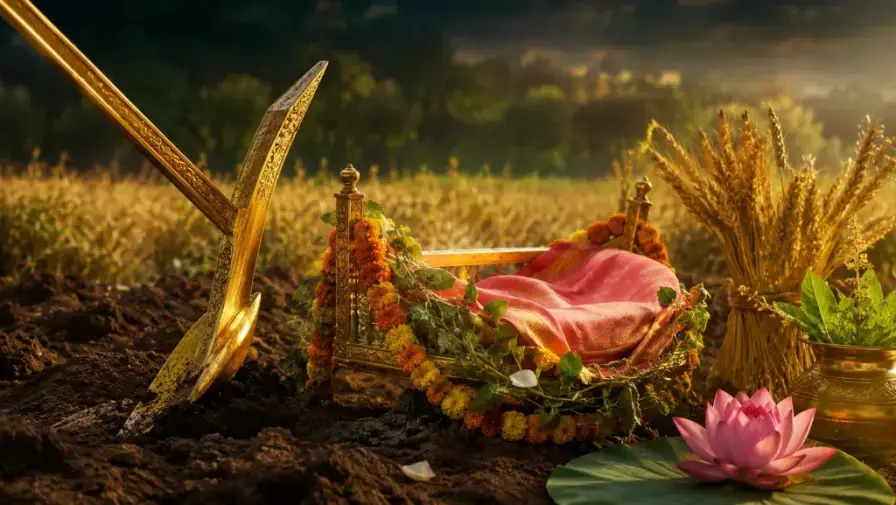
Sita Navami marks the appearance of Sita, whom the tradition honours as a form of the goddess Lakshmi and as the wife of Rama. The well-known account places her birth in Mithila, in the kingdom of Janaka: while the king was ploughing a field as part of a rite, a baby girl was found in the furrow. Because she was found in the earth, she is called Janaki (daughter of Janaka) and Bhumija (born of the earth). The day is also known as Sita Jayanti.
Sita's life runs alongside Rama's in the Ramayana — her marriage to Rama after he lifts the bow of Shiva, the fourteen-year exile she chooses to share, her abduction by Ravana, and the long separation that follows. What the day honours is less the events than her conduct: she is remembered for steadiness, patience, and loyalty held through hardship, and is taken as a model of those qualities, particularly within marriage. The festival is an occasion to revisit that example rather than only to mark a birth.
Sita Navami falls in Vaishakha, about a month after Ram Navami, which marks Rama's birth in the earlier month of Chaitra. For many households the two days are felt as a pair — the husband's day and the wife's day — and Sita is rarely worshipped apart from Rama, so the puja is usually offered to Sita and Rama together.
Rituals & observance
How Sita Navami is kept:
- The central rite is a Sita-Rama puja, with Sita worshipped alongside Rama rather than on her own; the main worship is generally done in the midday window.
- Many married women keep a day-long fast for the day, traditionally with the well-being and long life of their husband in mind, breaking it after the worship.
- Households and temples hold readings from the Ramayana, especially the passages on Sita's appearance in Mithila and her marriage to Rama.
- Devotees recite stotras to Sita and Rama and chant their names through the day; offerings of flowers, fruit, and seasonal items are common.
- Temples to Rama and Sita hold special darshan, and centres associated with Mithila and Janakpur mark the day with particular care.
Regional variations
How this date is determined
Observed on the Navami tithi of Vaishakha (Shukla paksha), reckoned by midday (madhyahna).
Dates are computed to astronomical precision (NASA/JPL ephemeris), in line with traditional panchang.