Shravana Putrada Ekadashi
Lord Vishnu
When it falls
The date shifts because it tracks the moon, not the Gregorian calendar.
Calculated for India (IST) using precise Panchang astronomy. Dates can shift by a day at locations far to the east or west.
Significance & story
Ekadashi is the eleventh lunar day, and there are two in every lunar month — one in each fortnight. Each carries its own name, presiding story and intention, but all are kept as a vrat (fasting observance) for Vishnu. Putrada means "giver of children", and the Shravana Putrada Ekadashi — the one falling in the bright fortnight (Shukla Paksha) of the month of Shravana — is traditionally observed by couples praying for a child, and by parents for the long life and wellbeing of children they already have.
The day belongs to the four-month Chaturmas period, when Vishnu is said to be in cosmic sleep and the religious calendar turns toward fasting, restraint and devotion rather than weddings and new ventures. The fast itself is the heart of the observance: a day of lightness and focus on Vishnu, closed by listening to or reading the Ekadashi's traditional story (katha) that explains how the vrat came to grant children to those who kept it sincerely.
There is a companion observance, Pausha Putrada Ekadashi, with the same name and intention in the month of Pausha. The two are distinct days half a year apart; this one is fixed to Shravana, which is why its Gregorian date lands in roughly July or August and shifts from year to year with the lunar calendar.
Rituals & observance
How the vrat is kept:
- The day is centred on a fast (vrat). Most observers keep a partial fast — no grains, rice, beans or lentils — taking only fruit, milk, water and permitted non-grain foods; the strict keep a full fast, and some abstain even from water.
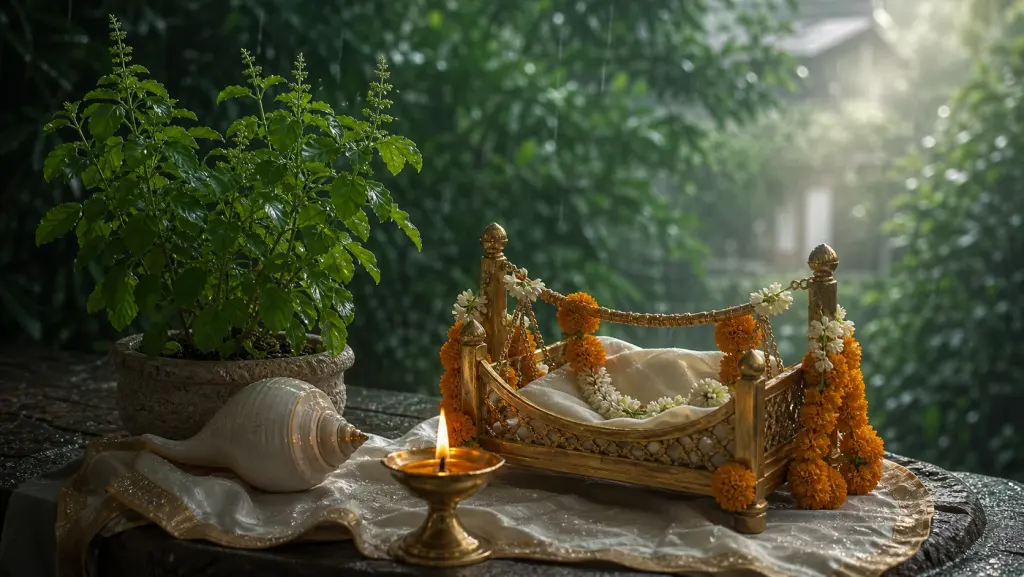
- Devotees bathe, then worship Vishnu — often as Krishna or as Lakshmi-Narayana — with offerings of flowers, tulsi (holy basil) leaves, fruit and a lamp.
- The traditional story (katha) of the Ekadashi is read or heard, since the merit of the vrat is tied to knowing and reciting it.
- The day is spent in restraint — avoiding onion, garlic and tamasic food, keeping a quiet, devotional mood, and many stay awake into the night in remembrance of Vishnu.
- The fast is broken the next morning (parana) during the following lunar day, Dwadashi, within the prescribed window — never before sunrise and not after Dwadashi has ended.
Regional variations
How this date is determined
Observed on the Ekadashi tithi of Shravana (Shukla paksha), reckoned by sunrise (udaya tithi).
Dates are computed to astronomical precision (NASA/JPL ephemeris), in line with traditional panchang.