Jhulan Yatra
Lord Krishna, Radha
When it falls
The date shifts because it tracks the moon, not the Gregorian calendar.
Calculated for India (IST) using precise Panchang astronomy. Dates can shift by a day at locations far to the east or west.
What Jhulan Yatra marks
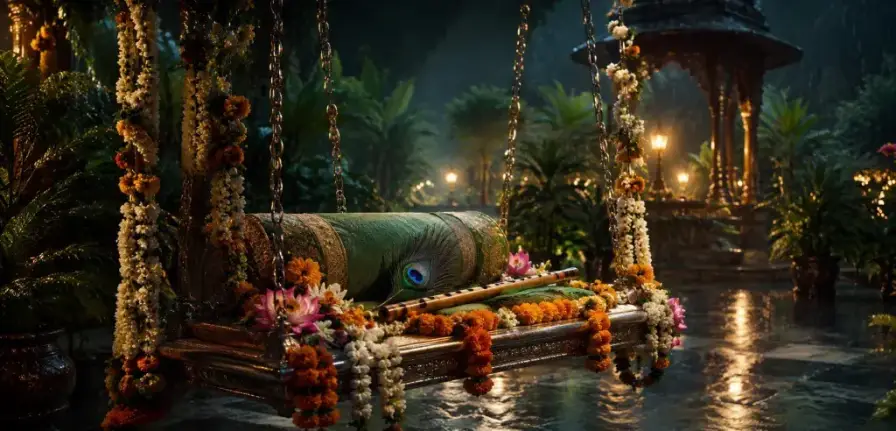
Jhulan Yatra recalls the leisure pastimes (lila) of Radha and Krishna during the rains. In the stories of Vrindavan, Krishna and Radha would sway together on a flower-decked swing in the gardens while their companions (the gopis and sakhis) sang and pushed the swing. The festival re-enacts that scene: devotees place the deities on a real swing and rock it, taking the part of those companions. Jhula simply means swing, and the festival is also called Jhulan Purnima or Hindola, the swing pastime.
It falls in the month of Shravan, the heart of the monsoon, when the land turns green and the rains set the mood. Traditions differ on the exact span, but the swinging usually runs over several days of the bright fortnight (Shukla paksha) and reaches its high point on the full-moon day, Shravan Purnima, which in many places coincides with Raksha Bandhan and Balarama's birth anniversary.
The festival is held most strongly in the Gaudiya Vaishnava tradition that traces back to Chaitanya Mahaprabhu, and so it is central in Vrindavan, Mathura, and Bengal, and is observed in temples worldwide. It is a festival of devotion expressed through beauty and play rather than fasting or austerity: the emphasis is on decorating the swing, dressing the deities well, and singing, so the days feel celebratory rather than solemn.
Rituals & observance
Customs vary by temple and household, but the swing is always the centre of the observance. These are the common threads over the days from 12 August 2027 to the full moon.
- Set up a swing (jhula or hindola) for the deities, decorated with flowers, garlands, fresh leaves, and coloured cloth, often hung in a mandap or before the home shrine.
- Place small images of Radha and Krishna, or of Krishna alone, on the swing and rock it gently while singing bhajans and kirtan, with devotees taking turns to push the swing.
- Dress and adorn the deities afresh, frequently in seasonal monsoon colours, and offer flowers, fruit, sweets, and other bhog before distributing it as prasad.
- Hold sandhya arati and devotional singing in the evenings through the bright fortnight, with the largest gathering and fullest decoration kept for the final day, Shravan Purnima.
- Visit a Krishna temple if you can; many keep the swing on public view through the festival so visitors can take darshan and help rock it.
Regional variations
How this date is determined
Observed on the Ekadashi tithi of Shravana (Shukla paksha), reckoned by sunrise (udaya tithi).
Dates are computed to astronomical precision (NASA/JPL ephemeris), in line with traditional panchang.