Pitrupaksha
When it falls
The date shifts because it tracks the moon, not the Gregorian calendar.
Calculated for India (IST) using precise Panchang astronomy. Dates can shift by a day at locations far to the east or west.
Significance & meaning
Pitrupaksha (literally the fortnight of the ancestors) is the time set aside each year to remember the people one comes from. In Hindu thought, the family does not end at the living: the recently departed — parents, grandparents and elders, collectively the pitr — remain owed care, and this fortnight is when that debt is repaid through ritual rather than grief. It is a quiet, inward observance, not a celebration; there are no lamps or fireworks, only food, water and remembrance.
The central act is shraddha — a rite performed with faith (the word itself comes from shraddha, meaning faith) — in which cooked food and water are formally offered to named ancestors so they are nourished and at peace. Most families perform the main shraddha on the tithi, the lunar day, on which the person died, which is why the fortnight gives sixteen days: enough lunar days to cover whichever one applies to your elders. Those who do not know the exact day, or who wish to honour all the departed together, do so on the final day.
That final day, the new moon of the dark fortnight, is Sarva Pitru Amavasya — when offerings are made to all ancestors at once. Pitrupaksha sits at a deliberate hinge in the calendar: it closes immediately before Sharad Navratri opens, so the year turns from honouring the dead to invoking the Goddess. Settling one's debt to the ancestors first is understood as the right order — duty before festivity.
Rituals & observance
How Pitrupaksha is kept:
- The core rite is shraddha — offering cooked food and water to named ancestors, performed on the tithi that matches the elder's day of passing, often guided by a priest.
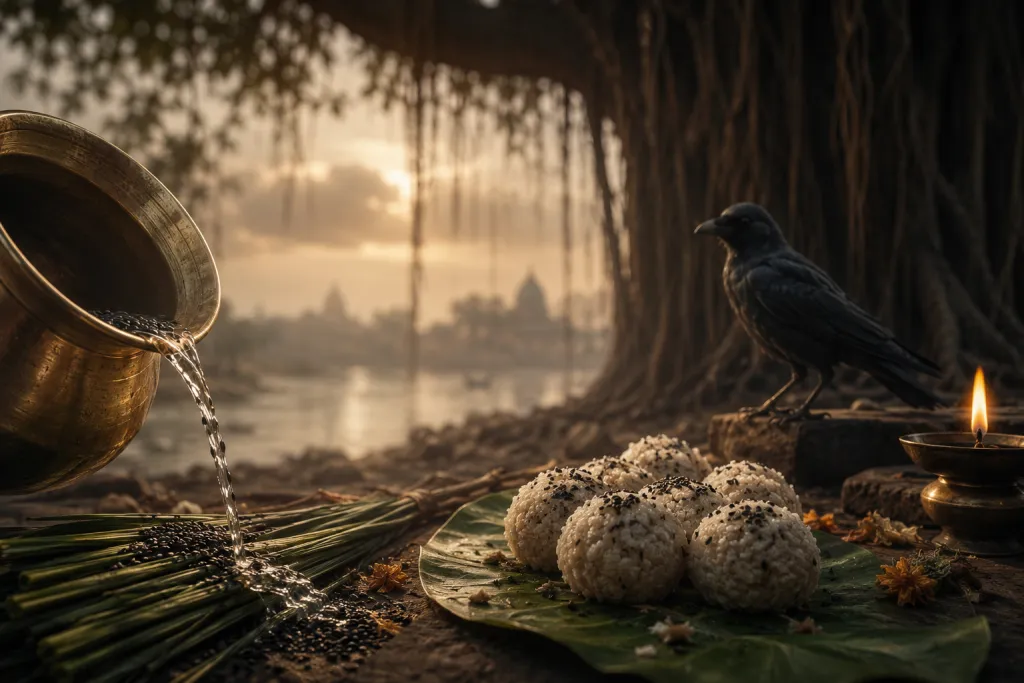
- Tarpan, the daily offering of water (frequently mixed with black sesame seeds) to the ancestors, is made in the morning, typically by the eldest son or the person carrying the family duty.
- Pind-daan — offering rounded balls of cooked rice or barley (pind) — is performed for the departed, classically at a sacred river or tirtha such as Gaya, though it is also done at home.
- A portion of the day's food is set aside for the ancestors and commonly given to a crow, a cow, a dog or a guest, who are seen as receiving the offering on their behalf.
- Brahmins, the needy or guests are fed, since feeding others is held to reach the ancestors as well — the giving matters more than the scale of it.
- Many families keep the fortnight simple and restrained: avoiding new purchases, weddings and other auspicious beginnings, and keeping the focus on remembrance rather than festivity.
Regional variations
How this date is determined
Observed on the Pratipada tithi of Ashwin (Krishna paksha), reckoned by the afternoon (aparahna). Should the tithi fall across two days, tradition keeps the earlier day (purva-viddha).
Dates are computed to astronomical precision (NASA/JPL ephemeris), in line with traditional panchang.