Papamochani Ekadashi
Lord Vishnu
When it falls
The date shifts because it tracks the moon, not the Gregorian calendar.
Calculated for India (IST) using precise Panchang astronomy. Dates can shift by a day at locations far to the east or west.
What Papamochani Ekadashi marks
Papamochani Ekadashi is one of the twenty-four Ekadashis kept each year — the eleventh lunar day (tithi) of every fortnight is sacred to Vishnu, and a fast is observed on it. This particular one falls in the waning fortnight (Krishna paksha) of Chaitra, the last lunar month of the Hindu year, which makes it the final Ekadashi before the year turns. It sits in the stretch between Holi and the start of Chaitra Navratri.
The name carries the whole meaning of the day: papa is sin or wrongdoing, mochana is release, so Papamochani is "the one that frees from sin." The merit of the vrat is recounted in the Puranic literature, where Krishna explains its power to Yudhishthira through an older story of a sage who recovered his standing by keeping this fast. The thread is consistent across the Ekadashi tradition: the point is not a transaction but a deliberate turning of attention back toward Vishnu and away from the habits that accumulate as regret.
Because it closes the year, observers often treat Papamochani as a chance to set down the past before the new cycle. There is no large public festival attached to it — it is a quiet, personal observance, kept at home or at a Vishnu temple, and its weight comes from the fast and the remembrance rather than from any procession or feast.
Rituals & observance
The observance is the Ekadashi vrat in its standard form: a day given to fasting and to Vishnu, followed by breaking the fast at the correct time the next morning. The fast can be kept strictly (no food) or partially (one sattvic meal of permitted foods), according to ability and custom.
- Wake and bathe before dawn, then make a sankalpa — a simple resolve to keep the fast for the day and offer it to Vishnu.
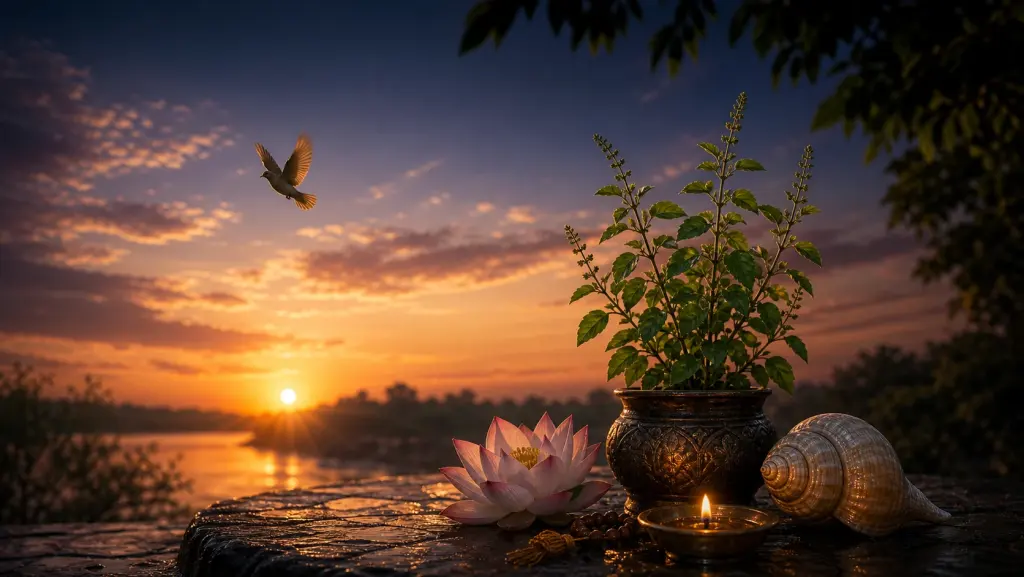
- Worship Vishnu (often as Krishna) with tulsi leaves, flowers, incense, and a lamp; reading or hearing the day's story (vrat katha) and chanting Vishnu's names are the heart of the observance.
- Keep the fast through the day. The strict form takes nothing but water; a partial fast allows fruit, milk, and root vegetables while avoiding grains, rice, lentils, and beans — the foods traditionally set aside on Ekadashi.
- Set aside onion, garlic, and any tamasic or stimulating food, and keep the day calm and free of conflict; many also keep a night vigil (jagaran) with bhajans.
- Give according to means — food, grain, or alms to those in need — which is a customary part of the day's merit.
- Break the fast (parana) the next morning, on Dwadashi, within the permitted window after sunrise. Eat only after the parana, beginning with something simple; never break it during the Ekadashi tithi itself or past the Dwadashi window.
How this date is determined
Observed on the Ekadashi tithi of Chaitra (Krishna paksha), reckoned by sunrise (udaya tithi).
Dates are computed to astronomical precision (NASA/JPL ephemeris), in line with traditional panchang.