Onam
Lord Vishnu
When it falls
The date shifts because it tracks the moon, not the Gregorian calendar.
Calculated for India (IST) using precise Panchang astronomy. Dates can shift by a day at locations far to the east or west.
A harvest festival shaped by remembrance and welcome
Onam is the great festival season of Kerala, beginning with Atham and reaching its high point ten days later on Thiruvonam. It arrives in Chingam, the first month of the Malayalam solar calendar, after the difficult monsoon month of Karkidakam and around the harvest season. That setting gives Onam its practical mood: the home is cleaned, food is prepared in abundance, relatives return, and the household makes room for guests.
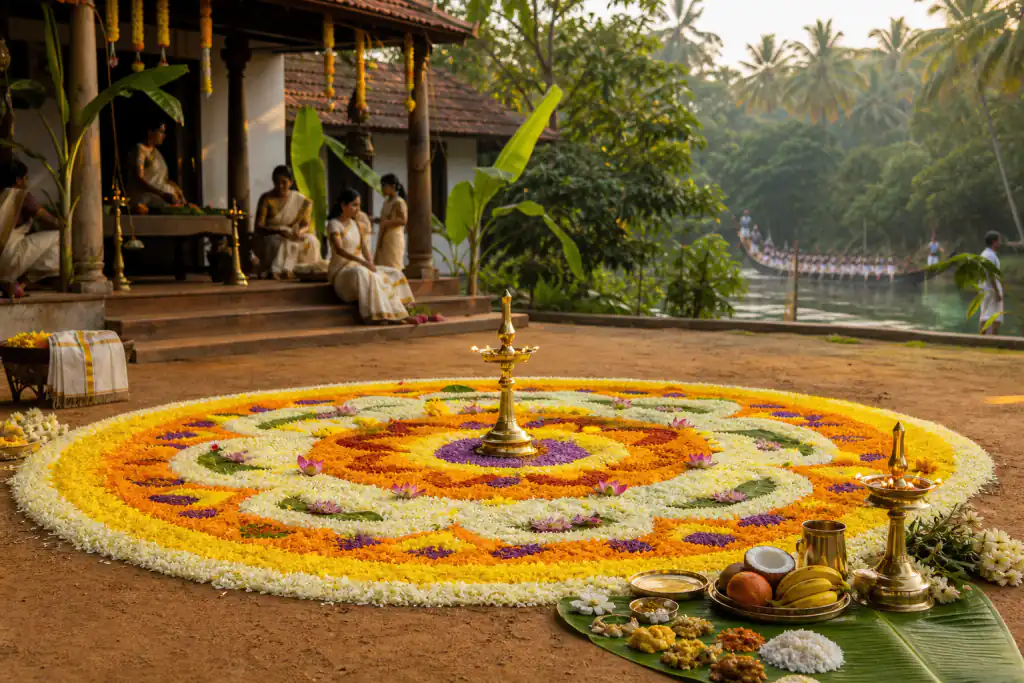
The central legend remembers Mahabali, the generous Asura king whose reign is described in Kerala's songs as a time of prosperity, fairness and freedom from want. In the Vamana story, Vishnu takes the form of a dwarf Brahmin and asks Mahabali for three paces of land. After Vamana covers earth and heaven in two strides, Mahabali offers his own head for the third. His devotion is honoured with permission to visit his people once every year. The pookalam at the threshold and the feast inside the home both express the same idea: the beloved king should find his land flourishing and his people united.
Thiruvonam is not chosen by a lunar tithi. It is a solar-nakshatra festival: the observance falls when Thiruvonam nakshatra, called Shravana elsewhere, prevails during Chingam, the Sun's month in Leo (Simha). This is why the Gregorian date moves within August or September and why a generic full-moon calendar cannot determine Onam correctly.
Rituals & observance
There is no single compulsory household procedure for Onam. Customs vary across Kerala, but the main practices all centre on preparing the home, welcoming Mahabali, sharing the harvest and spending the day with family.
- Build the pookalam: flower carpets begin simply on Atham and grow through the ten-day season. On Thiruvonam the finished design welcomes Mahabali at the entrance of the home; many families also place a Thrikkakarappan clay figure representing Vamana.
- Prepare the home: clean the house and courtyard, light the nilavilakku (traditional lamp), and set out fresh decorations. The preparation is part of the welcome, not merely festival ornament.
- Wear Onakkodi: new clothes are given to family members and worn on the main day. The gift is a practical expression of renewal and shared dignity within the household.
- Serve Onasadya: prepare a vegetarian feast with rice and several curries, pickles, chips and payasam, served on a banana leaf. The exact number of dishes differs by home; generosity and eating together matter more than an inflated dish count.
- Remember Mahabali and Vamana: families may make a simple offering before the lamp, at the pookalam or before the sadya. Temple-going households may visit a Vishnu or Vamana temple, especially Thrikkakara.
- Share the festival: family visits, gifts, games, music and local arts are part of Onam. Public events may include vallamkali boat races, Pulikali, Kathakali and Thiruvathirakali, but these are cultural celebrations rather than required household rites.
Regional variations
How this date is determined
Observed when the specified lunar nakshatra prevails during the specified solar month.
Dates are computed to astronomical precision (NASA/JPL ephemeris), in line with traditional panchang.