Narasimha Jayanti
Lord Narasimha
When it falls
The date shifts because it tracks the moon, not the Gregorian calendar.
Calculated for India (IST) using precise Panchang astronomy. Dates can shift by a day at locations far to the east or west.
Who Lord Narasimha is, and why the day matters
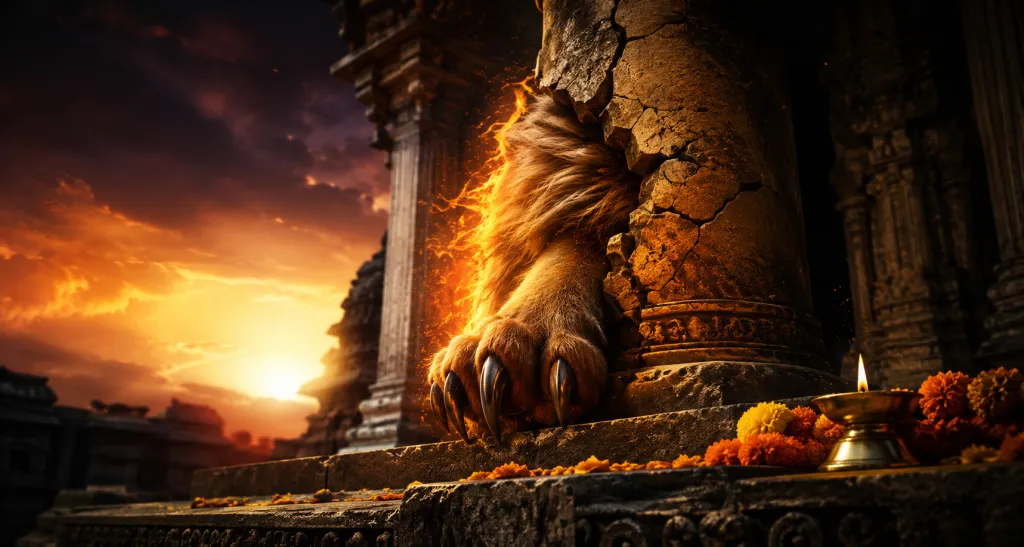
Narasimha is the fourth of the ten principal avatars (Dashavatara) of Vishnu, with the body of a man and the head and claws of a lion. He appeared to end the demon-king Hiranyakashipu, who had won a boon that he could not be killed by man or beast, by day or night, indoors or outdoors, on the ground or in the sky, by any weapon. Narasimha's form answered every clause of that boon at once: neither fully man nor beast, at twilight, on a threshold, on his own lap, torn apart by claws rather than a weapon.
At the heart of the story is Prahlad, Hiranyakashipu's young son, who remained a steady devotee of Vishnu even as his father persecuted him. When the king demanded to know whether his god was present in a pillar of the hall, Narasimha burst from it. For this reason the day is read less as a celebration of destruction and more as an assurance that sincere devotion is protected, and that arrogance and cruelty meet their limit.
The tithi is Vaishakha Shukla Chaturdashi, the fourteenth day of the bright fortnight of Vaishakha (April-May). Because Narasimha is said to have appeared at sandhya, the junction of day and night, the observance is timed to the evening rather than to sunrise, which shapes how the fast and puja are kept.
Rituals & observance
Narasimha Jayanti is observed with a day-long fast and an evening puja, echoing the twilight hour of the avatar's appearance. Practices vary by family and region; the essentials below are widely followed.
- Keep a fast (vrat) through the day. Many devotees take only water or fruit and break the fast after sunset, once the evening puja is complete, since Narasimha appeared at dusk.
- Bathe and worship an image of Lord Narasimha, often shown with Prahlad and the slain Hiranyakashipu. Offerings commonly include flowers, sandal paste, fruit, and cooling foods suited to the Vaishakha heat.
- Recite or listen to Narasimha-related texts and prayers, such as the Narasimha story from the Bhagavata Purana and the Narasimha Kavacham or stotras, in temples and at home.
- Light a lamp and perform aarti at sandhya (the evening junction), the time traditionally linked to the avatar's appearance.
- Give to those in need (daan) as part of the day's merit; donating water, food, or cooling items is common in the hot season.
- Break the fast (parana) after the evening worship, on the following day where local custom prescribes it.
How this date is determined
Observed on the Chaturdashi tithi of Vaishakha (Shukla paksha), reckoned by sunset (sayana kala).
Dates are computed to astronomical precision (NASA/JPL ephemeris), in line with traditional panchang.