Holika Dahan
Prahlad
When it falls
The date shifts because it tracks the moon, not the Gregorian calendar.
Calculated for India (IST) using precise Panchang astronomy. Dates can shift by a day at locations far to the east or west.
Holi
The story of Prahlad and the burning of Holika
Holika Dahan takes its name from the demoness Holika, sister of the king Hiranyakashipu. In the traditional account, Hiranyakashipu demanded that everyone worship him as a god, but his own son Prahlad stayed devoted to Vishnu. After repeated attempts to break the boy's faith failed, the king turned to his sister, who held a boon protecting her from fire.
Holika sat in a blazing pyre with Prahlad on her lap, expecting the flames to spare her and consume the child. The story tells that the protection failed when she used it against the innocent: Holika was burned, while Prahlad, absorbed in his devotion, came through unharmed. The bonfire each year re-enacts this moment.
The meaning people draw from it is simple — the festival marks the burning away of arrogance and ill-will, and the survival of sincere faith. It falls on the full-moon night (Purnima) of the month of Phalguna, and the fire stands as a public, shared ending before the colours of Holi begin the next morning.
Rituals & observance
The central act is the lighting of a community bonfire after dusk (pradosh), the period that classical texts prescribe for this rite. Observances vary by household and region, but the common elements are these:
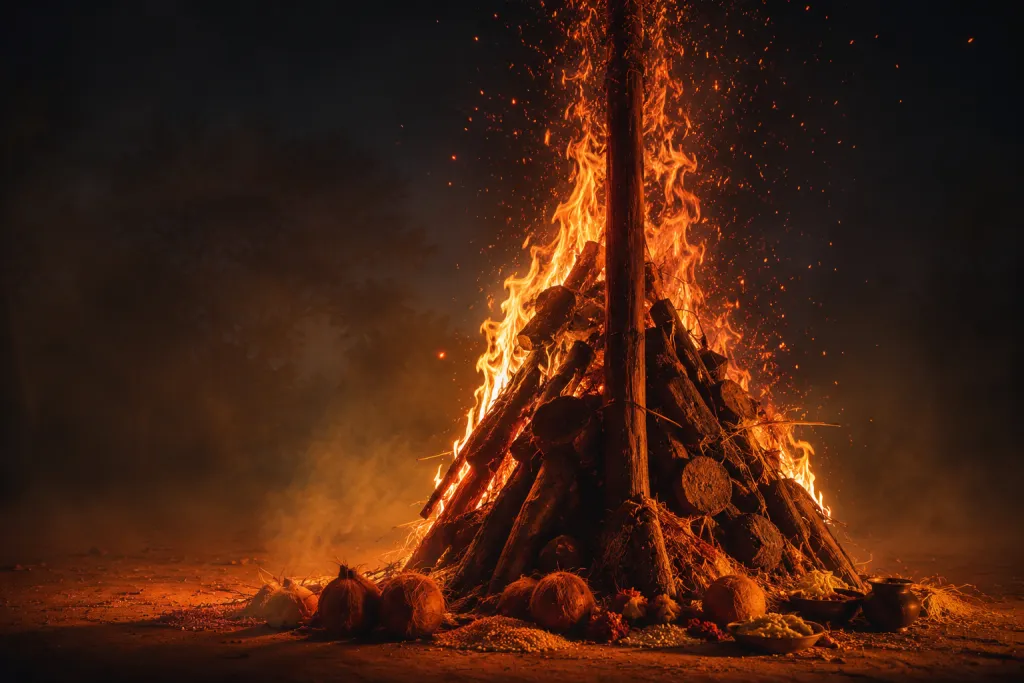
- In the days before, a pile of wood, dried cow-dung cakes, and combustible scrap is built up at a crossroads or open ground, often with a pole representing Holika at its centre.
- The fire is lit after sunset during the pradosh window, while the Purnima tithi is in effect and outside the Bhadra period — which is why the muhurat matters.
- Families circle the fire and offer grains, coconut, and seasonal harvest items such as ears of wheat and gram, which are roasted in the flames.
- Many walk a few circumambulations (parikrama) around the fire and offer water before leaving, asking protection for the household over the coming year.
- Ash and roasted grain from the bonfire are carried home; some apply a little ash to the forehead as a mark of the night.
- The gathering doubles as a community event — singing, drumming, and the lighting itself draw the neighbourhood together before Holi the following day.
Regional variations
How this date is determined
Observed on the full-moon day (Purnima) of Phalguna (Shukla paksha), reckoned by dusk (pradosh kala). Should the tithi fall across two days, tradition keeps the earlier day (purva-viddha).
Dates are computed to astronomical precision (NASA/JPL ephemeris), in line with traditional panchang.