Kumbha Sankranti
When it falls
The date shifts because it tracks the moon, not the Gregorian calendar.
Calculated for India (IST) using precise Panchang astronomy. Dates can shift by a day at locations far to the east or west.
Significance & meaning
Kumbha Sankranti is one of the twelve sankrantis — the days on which the Sun (Surya) moves from one zodiac sign into the next. On this day the Sun leaves Capricorn (Makara) and enters Aquarius (Kumbha). It is a solar event, computed from the Sun's actual position in the sky, which is why it falls on roughly the same calendar date each year and does not swing across weeks the way Moon-based festivals do.
In the religious calendar a sankranti is treated as a threshold, and the hours around the exact ingress are considered the most worthwhile (punya kaal) for a holy bath and for giving. Kumbha Sankranti is a lower-key observance than the more widely kept Makar Sankranti, but the same logic applies: the turn of the Sun into a new sign is a moment to bathe, give, and offer water to Surya rather than a day of large public celebration.
It falls during the cooler, settled stretch of the year, well within the Sun's northward course (Uttarayan) that began at Makar Sankranti. For most observers it is a day of personal devotion and charity rather than feasting — a quiet marker that the Sun has moved on another step through the zodiac.
Rituals & observance
How Kumbha Sankranti is kept:
- The central observance is a dawn holy bath (snan) in a river or sacred water-source, taken during the punya kaal — the meritorious window around the Sun's ingress.
- Giving (daan) follows the bath — typically grain, sesame, warm clothing or food offered to those in need, considered especially fruitful on a sankranti.
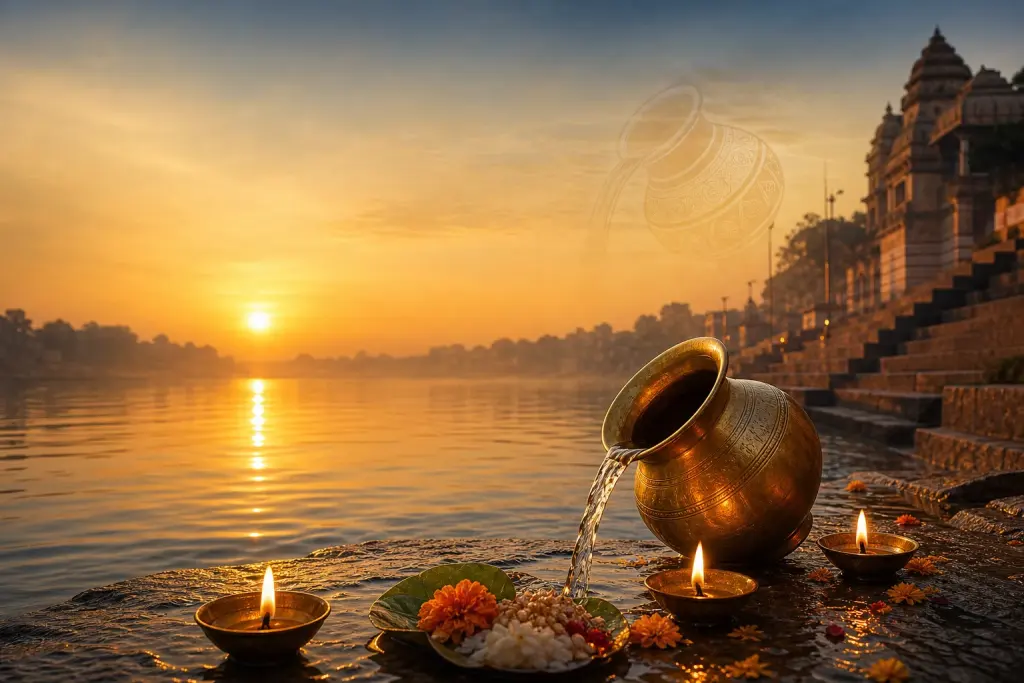
- Water is offered to the rising Sun (arghya to Surya), often with a short prayer, as a mark of gratitude on the day of the solar turn.
- Pilgrims gather at major river banks and bathing ghats; where a sankranti coincides with a larger bathing event, taking a dip at a confluence (sangam) is held in particular regard.
- Many keep the day with a simple fast or light, plain food, treating it as a day of devotion and restraint rather than feasting.
Regional variations
How this date is determined
Observed on the sankranti, the day the Sun crosses into a new zodiac sign.
Dates are computed to astronomical precision (NASA/JPL ephemeris), in line with traditional panchang.