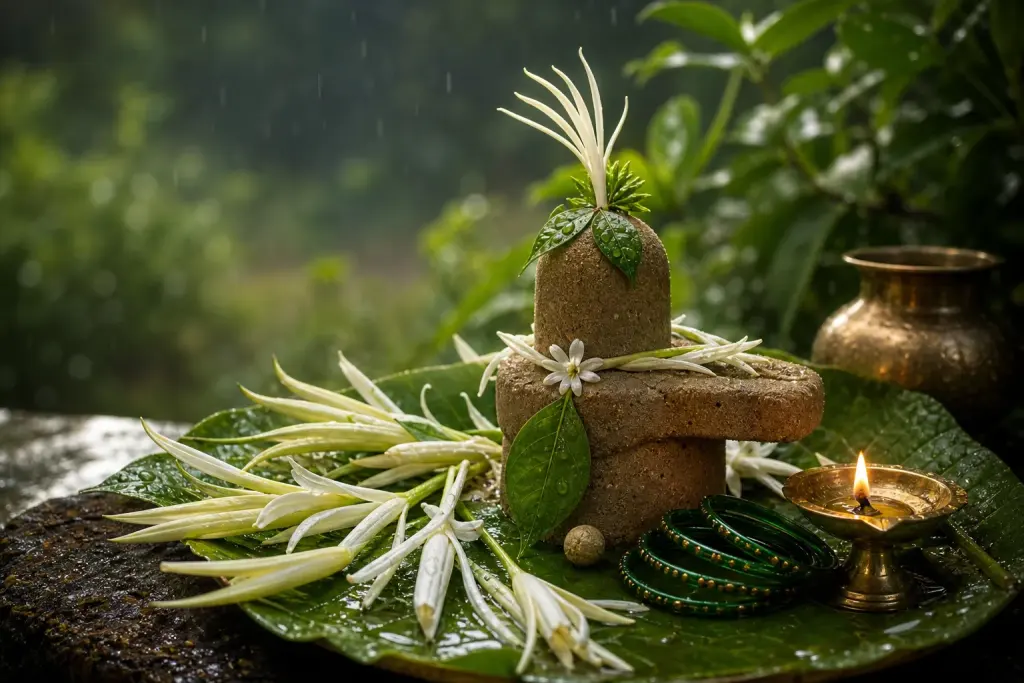
Kevda Trij
Goddess Parvati
When it falls
The date shifts because it tracks the moon, not the Gregorian calendar.
Calculated for India (IST) using precise Panchang astronomy. Dates can shift by a day at locations far to the east or west.
The story behind the fast
Kevda Trij is the Gujarati name for the fast kept across much of India as Hartalika Teej. Both fall on the same day, Bhadrapada Shukla Tritiya, and both recall how Parvati won Shiva as her husband through her own resolve rather than her family's choice. In the popular telling, a friend carried Parvati away into the forest so she would not be married against her wish; there she shaped an image of Shiva from sand and kept a strict fast until he accepted her. Women keep the day in that spirit, as a vow of constancy rather than a claim that fasting changes fate.
The local name comes from the kevda (screwpine) flower, whose strong fragrance makes it a favoured offering to Shiva on this day. The flower gives the Gujarati observance its distinct character, but the intent is the one shared by all three Teej fasts: married women keep it for the long life and well-being of their husbands, and unmarried women keep it hoping for a good partner.
Kevda Trij sits a day before Ganesh Chaturthi, so in many Gujarati homes the quiet, fasting tone of Trij gives way the next morning to the arrival of Ganesha. The two run back to back, and households often prepare for both together.
Rituals & observance
The day centres on a fast and the worship of Parvati and Shiva, with kevda flowers as the signature offering. Practices vary by family, but most observances include the following:
- Keep a fast for the day. The traditional form is a strict waterless (nirjala) fast from sunrise; those who cannot manage it keep a lighter fruit-and-milk (phalahari) version, and elders or those who are unwell take an easier form.
- Worship clay or sand images of Parvati (Gauri) and Shiva, often with Ganesha placed beside them, set on a decorated platform for the day.
- Offer kevda (screwpine) flowers to Shiva along with water, bel leaves, vermilion (sindoor), and a lamp; the kevda's fragrance is the offering that gives the day its name.
- Dress in traditional finery, with married women wearing wedding ornaments and bangles as part of the day's worship.
- Listen to or recite the vrat katha so the reason for the fast is renewed each year rather than only kept by habit.
- Break the fast after the concluding puja, commonly the next morning, sharing the offered fruit and prasad with family and other women keeping the vrat.
Regional variations
How this date is determined
Observed on the Tritiya tithi of Bhadrapada (Shukla paksha), reckoned by the forenoon (purvahna). Should the tithi fall across two days, tradition keeps the later day (para-viddha).
Dates are computed to astronomical precision (NASA/JPL ephemeris), in line with traditional panchang.