Ganesh Chaturthi
Lord Ganesha
When it falls
The date shifts because it tracks the moon, not the Gregorian calendar.
Calculated for India (IST) using precise Panchang astronomy. Dates can shift by a day at locations far to the east or west.
Significance & story
Ganesh Chaturthi marks the birth of Lord Ganesha (Ganapati), the elephant-headed son of Shiva and Parvati. He is worshipped first in almost every Hindu rite — before a wedding, a new business, a journey, or an exam — because he is the remover of obstacles (Vighnaharta), the one who clears the path. The festival is when that everyday household deity is given his own days of full attention.
The familiar story explains the elephant head. Parvati made a boy from turmeric paste to guard her door, and he stopped even Shiva from entering. In the clash that followed the boy's head was severed, and to console Parvati, Shiva restored him to life with the head of the first creature found — an elephant. Beyond the story, Ganesha stands for a simple idea: begin well, and the rest follows. He is honoured at the start because beginnings set the course for what comes after.
What makes the festival distinctive is its arc. A clay idol is brought home or to a community pandal, treated as an honoured guest for the days he stays, and then carried out to a river, lake or sea and immersed. The welcome and the farewell are both part of the worship — the deity arrives, is cared for, and is sent off, a full cycle rather than a single day's prayer.
Rituals & observance
How Ganesh Chaturthi is kept:
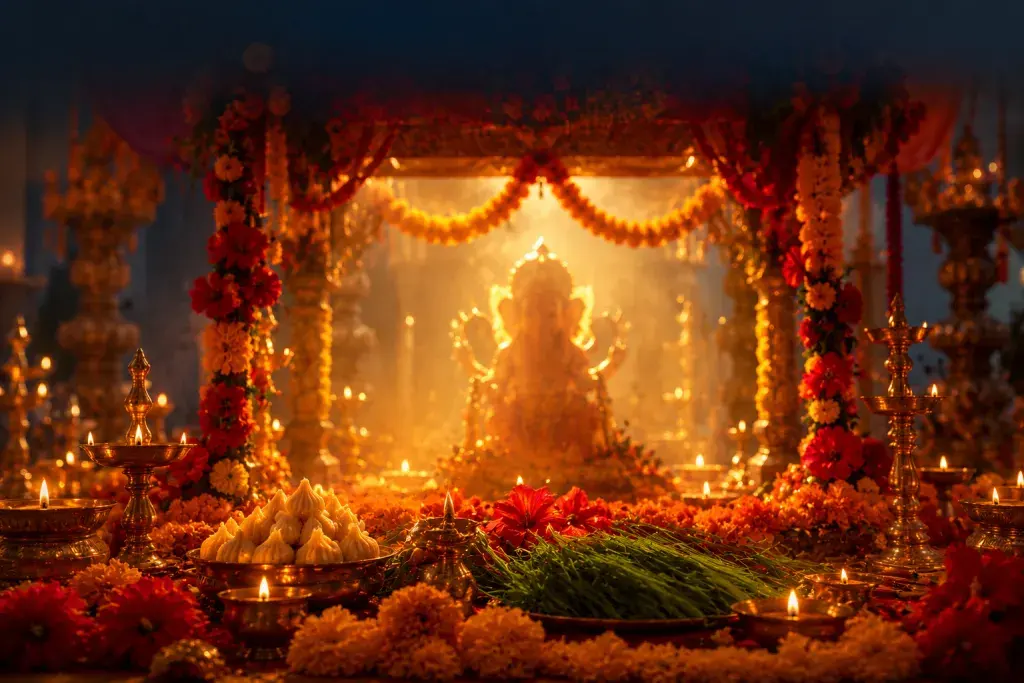
- A clay idol (murti) of Ganesha is installed at home or in a public pandal — the invocation that invites the deity to reside in the image (pranapratishtha) — followed by the main sixteen-step offering (shodashopachara puja), done at the midday window (madhyahna).
- A steamed sweet dumpling held to be Ganesha's favourite (modak) is offered, along with durva grass — the tender three-bladed grass given to him — and red flowers.
- The idol is worshipped daily for the days it stays — one and a half, three, five, seven or ten days, by family custom — with morning and evening aarti.
- Public pandals host the deity for the community, with shared aarti, cultural programmes and prasad through the festival.
- The festival closes with the immersion (visarjan), carrying the idol in procession to water — on Anant Chaturdashi for the full ten-day observance. See Anant Chaturdashi.
- By custom the moon is not viewed on the night of Chaturthi — a folk belief holds that seeing it then invites false blame, so many deliberately avoid looking at it.
Regional variations
How this date is determined
Observed on the Chaturthi tithi of Bhadrapada (Shukla paksha), reckoned by midday (madhyahna). Should the tithi fall across two days, tradition keeps the day with the greater overlap (adhika-vyapti).
Dates are computed to astronomical precision (NASA/JPL ephemeris), in line with traditional panchang.