Jivati Pujan
Jara-Jivantika
Dates in 2027
A monthly observance — here are its dates through this year.
Calculated for India (IST) using precise Panchang astronomy. Dates can shift by a day at locations far to the east or west.
What Jara-Jivantika Pujan means
Jivati Pujan is a Shravan Friday observance centred on Jara-Jivantika, remembered in Maharashtrian household tradition as a protective maternal presence. Parents, especially mothers in the customary form of the vrat, pray for their children's safety, wellbeing, and a full life.
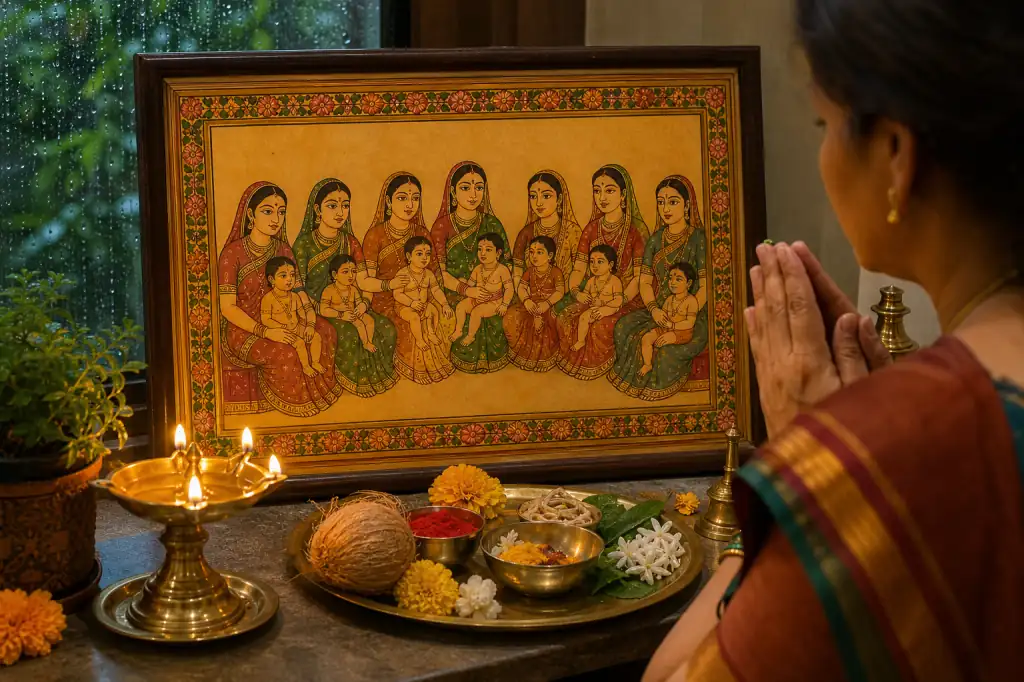
A familiar feature is the illustrated Jivati paper kept at the home shrine, often showing maternal figures with children. The image gives the prayer a visible focus, but the observance is not a substitute for healthcare or a promise that harm cannot occur. Its meaning is devotional care, responsibility, and hope for the child.
The puja repeats on the Fridays within Maharashtra's Amanta Shravan. Practices such as preparing a sweet offering, making lamps from puran, performing aarti, or honouring children are found in some households, while other families keep a simpler prayer. Local and family practice should be described honestly rather than combined into one compulsory ritual.
Rituals & observance
Jivati Pujan is kept at home with a Jara-Jivantika image and prayer for children. The following are common Maharashtra practices, not a universal mandatory sequence.
- Placing the Jivati image: a traditional Jara-Jivantika paper or framed image is set at the cleaned home shrine and decorated with flowers.
- Lighting the lamp and offering puja: a lamp, turmeric-kumkum, flowers, and the household's usual naivedya are offered with prayer.
- Remembering each child: parents pray for the wellbeing of their children; when a child is away, some families remember the child by name during the aarti.
- Puran offerings in some homes: Maharashtrian traditions may prepare puran and small puran lamps for the aarti, but this should not be presented as the only valid form.
- Sharing prasad and completing the Friday vrat: prasad is shared after worship, and any fast is concluded according to family practice and personal health.
Regional variations
How this date is determined
Set by the lunar calendar, reckoned by sunrise (udaya tithi).
Dates are computed to astronomical precision (NASA/JPL ephemeris), in line with traditional panchang.