Indira Ekadashi
Lord Vishnu
When it falls
The date shifts because it tracks the moon, not the Gregorian calendar.
Calculated for India (IST) using precise Panchang astronomy. Dates can shift by a day at locations far to the east or west.
What Indira Ekadashi marks
Indira Ekadashi is the eleventh day (Ekadashi) of the waning fortnight (Krishna Paksha) of the month of Ashwin. Like every Ekadashi it is dedicated to Vishnu, but its distinct place in the calendar is what sets it apart: it falls squarely within Pitru Paksha, the fortnight set aside for remembering and feeding one's ancestors. That timing gives the day its particular focus.
While most Ekadashis are kept mainly for personal merit and freedom from past wrongs, Indira Ekadashi is traditionally observed for the sake of those who have passed. The well-known story attached to it, from the Brahmavaivarta Purana, tells of a king named Indrasena who keeps this fast so that the merit reaches his late father and eases his condition. From this the day came to be understood as one whose merit can be offered on behalf of departed elders rather than kept for oneself.
In practice this means many families fold Indira Ekadashi into their wider Pitru Paksha observances. The fast is the same austerity any Ekadashi asks for, but the intention behind it is turned toward the ancestors. It recurs each lunar month as one of the year's twenty-four Ekadashis; Indira is specifically the one tied to Ashwin's dark fortnight and to Pitru Paksha.
Rituals & observance
Indira Ekadashi is kept as a day-long fast with worship of Vishnu, and, because of its place in Pitru Paksha, with remembrance of one's ancestors. The observance runs from sunrise on the Ekadashi to the parana the next morning.
- Begin the fast at sunrise on Ekadashi. Many keep a full fast; others take a single light meal of permitted foods (fruit, milk, certain non-grain items) and avoid rice, lentils, and regular grains for the day.
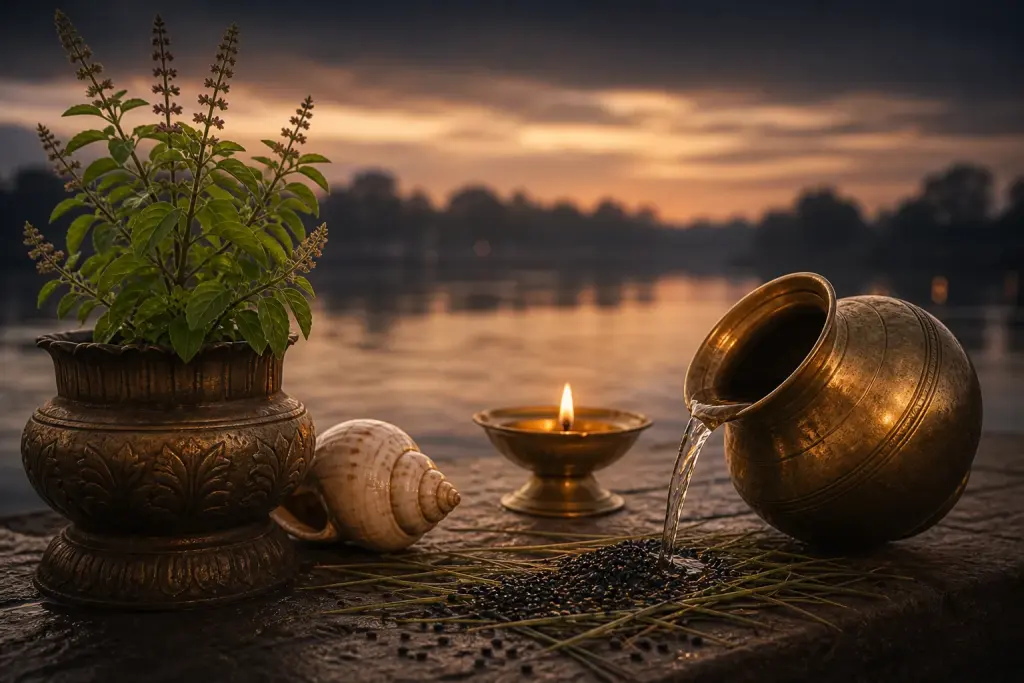
- Bathe and offer worship to Vishnu — a lamp, water, tulsi leaves, and a simple offering before his image, with recitation of his names or a Vishnu stotra as the household prefers.
- Remember the ancestors as part of the day's intention. Where the family already keeps Pitru Paksha, the tarpan and shraddha offerings made during this fortnight are naturally joined to the fast, with the day's merit dedicated to departed elders.
- Keep the day simple and disciplined — avoid grains, onion and garlic, and indulgence, and spend it in worship, charity, or feeding others rather than in entertainment.
- Stay watchful through the night where the tradition is kept, with reading or chanting in Vishnu's name.
- Break the fast (parana) the next morning, after sunrise and within the prescribed window, ideally by first offering food to a Brahmin or to someone in need before eating yourself.
How this date is determined
Observed on the Ekadashi tithi of Ashwin (Krishna paksha), reckoned by sunrise (udaya tithi).
Dates are computed to astronomical precision (NASA/JPL ephemeris), in line with traditional panchang.