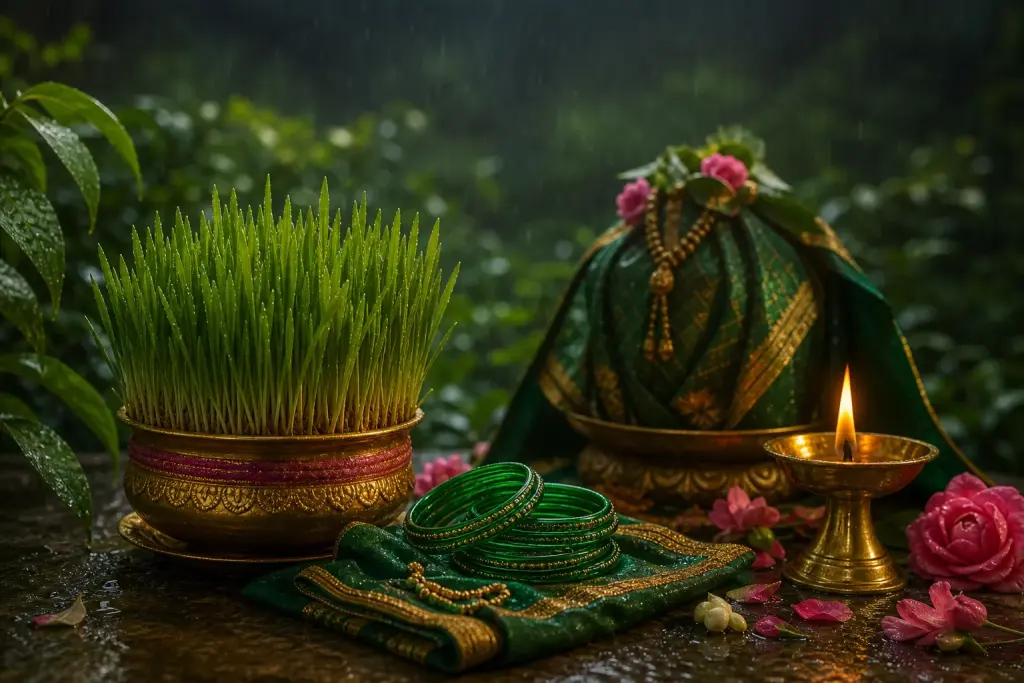
Gauri Vrat
Goddess Gauri
When it falls
The date shifts because it tracks the moon, not the Gregorian calendar.
Calculated for India (IST) using precise Panchang astronomy. Dates can shift by a day at locations far to the east or west.
The story and meaning of Gauri Vrat
Gauri Vrat is one of the monsoon vrats kept in honour of Goddess Gauri, another name for Parvati, the consort of Shiva. In tradition, Parvati herself won Shiva as her husband through long, patient devotion and penance. That story is the heart of the vrat: unmarried girls keep the fast hoping for a worthy, caring husband and a steady married life, taking Parvati's own devotion as the model to follow.
The vrat is mainly a Gujarati observance and falls during the bright fortnight of the lunar month of Ashadha (Ashadh), in the early part of the monsoon. It begins on the eleventh day (Ekadashi) of that fortnight, the same day as Devshayani Ekadashi, and runs for five days until the full-moon day, Guru Purnima. Because it opens this stretch, it is sometimes simply listed as Gauri Vrat Begins.
It is a Medium-importance vrat rather than a large public festival, kept quietly at home and in small groups rather than with big temple events. In many Gujarati families it sits alongside Jaya Parvati Vrat, which starts two days later, so the two together form a connected season of devotion to Parvati during the rains.
Rituals & observance
The vrat is kept over five days, from Ashadha Shukla Ekadashi to Guru Purnima. The exact rules vary by family, but the common practices are these:
- Bathe and worship Goddess Gauri (Parvati) each morning for the five days, usually with a small clay or metal image, or a representation made for the occasion.
- Keep a light fast rather than a total one: a common rule is a single wheat-based meal a day while avoiding other grains, and many girls also avoid salt or take only fruit and milk.
- Sow wheat or other grains in a small pot at the start and tend the sprouts through the vrat, treating the growing shoots as part of the worship.
- Offer flowers, kumkum, and simple food to the goddess daily, and listen to or recite the story (katha) linked to Parvati's devotion to Shiva.
- Keep the worship through all five days without breaks, since the continuity of the daily fast and prayer is the core of the vow.
- Conclude on the fifth day, Guru Purnima, with a closing puja, after which the fast is formally broken.
Regional variations
How this date is determined
Observed on the Ekadashi tithi of Ashadha (Shukla paksha), reckoned by sunrise (udaya tithi).
Dates are computed to astronomical precision (NASA/JPL ephemeris), in line with traditional panchang.