Jaya Parvati Vrat
Goddess Parvati
When it falls
The date shifts because it tracks the moon, not the Gregorian calendar.
Calculated for India (IST) using precise Panchang astronomy. Dates can shift by a day at locations far to the east or west.
The story behind the fast
Jaya Parvati Vrat is kept in honour of Goddess Parvati (Gauri), the consort of Shiva, and is read as a vow for marital happiness. Unmarried women keep it hoping for a good husband; married women keep it for the long life and well-being of their husbands. The name links the fast to Parvati in her form as Jaya, and the observance holds up her devotion and constancy as the example to follow.
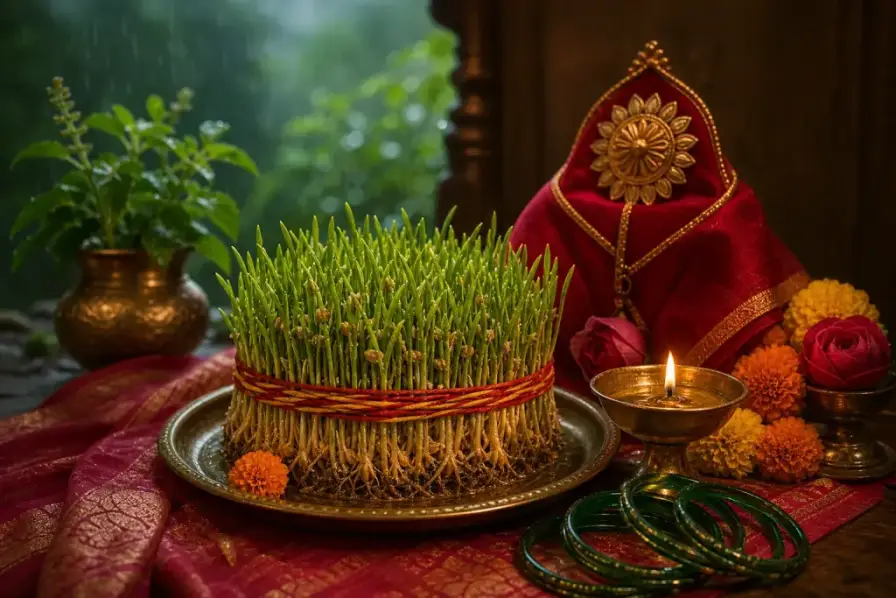
The vrat is best known for its seedlings. A few days before it begins, women sow wheat and other grains in small earthen pots; over the days of the fast the seeds sprout into fresh green shoots called javara, which are watered and worshipped each day. The growing seedlings stand for fertility and a flourishing married life, and tending them is the heart of the ritual rather than a side custom.
The fast is most strongly associated with Gujarat, where it is one of the well-known women's vrats of the monsoon season. It begins on the thirteenth day of the bright fortnight (shukla trayodashi) of Ashadha and runs for five days, ending after the third day of the dark fortnight (krishna tritiya). It usually falls in June or July, a few weeks before the wider Shravan-month observances.
Rituals & observance
The vrat runs across five days and is built around a partial fast and the daily care and worship of the javara seedlings. Practices vary by family, but most include the following:
- Sow the seedlings (javara): a few days before the fast, wheat or a mix of grains is sown in a small earthen pot and kept moist so it sprouts into fresh green shoots by the time the worship begins.
- Keep a five-day fast: many women take a saltless diet of fruit, milk, and simple uncooked or lightly prepared food for the five days, avoiding grains and salt. The strictness varies, and elders or those who are unwell keep a lighter version.
- Daily worship of the seedlings: the sprouted javara are watered and honoured each day with water, vermilion (sindoor), flowers, and a lamp, alongside images of Parvati and Shiva.
- Recite the vrat katha: the story behind the fast is read or told so the reason for keeping it is renewed each year rather than only kept by habit.
- Night vigil (jagran) on the last night: the final night is often spent awake in worship and devotional singing before the vrat is concluded the next morning.
- Conclude and immerse: after the closing worship the fast is broken, and the javara seedlings are gently immersed in a river or pond, returning them as the observance ends.
Regional variations
How this date is determined
Observed on the Trayodashi tithi of Ashadha (Shukla paksha), reckoned by sunrise (udaya tithi).
Dates are computed to astronomical precision (NASA/JPL ephemeris), in line with traditional panchang.