Deep Amavasya
When it falls
The date shifts because it tracks the moon, not the Gregorian calendar.
Calculated for India (IST) using precise Panchang astronomy. Dates can shift by a day at locations far to the east or west.
What Deep Amavasya means
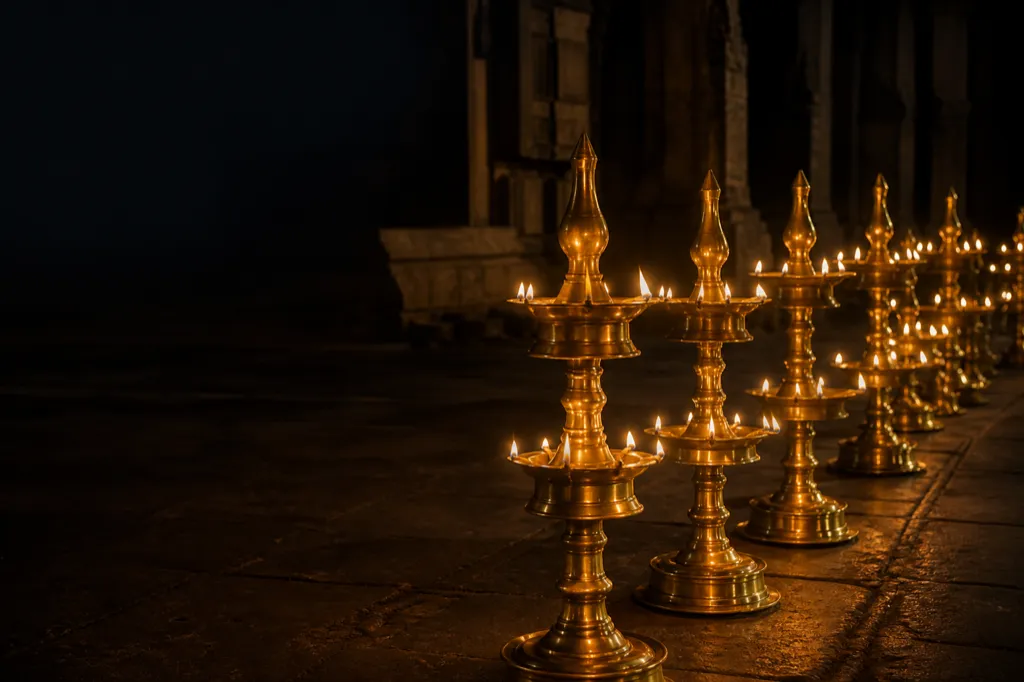
Deep Amavasya is the Amavasya at the close of Ashadha in Maharashtra's Amanta calendar, the day before Shravan begins. Its traditional name, Divyanchi Amavasya or the Amavasya of lamps, points directly to the household observance: the lamps used in daily worship are cleaned, restored, and honoured.
The focus is not a Diwali-style public display. Families gather their brass samai, niranjan, and other oil lamps, clean and polish them, arrange them near the home shrine, draw rangoli, light the wicks, and perform deep puja. In some homes, sweet lamps shaped from wheat flour, jaggery, and ghee are steamed, offered as naivedya, and then eaten as prasad.
The same civil day is popularly associated with the name Gatari Amavasya, because it falls just before the dietary restraints many households keep during Shravan. That colloquial feasting custom is not the meaning of deep puja itself. This page keeps the traditional lamp-worship observance at the centre while acknowledging the later popular name without treating indulgence as a religious requirement.
Rituals & observance
Deep Amavasya is primarily a household observance. Customs vary, but the lamps themselves—not a large public celebration—remain the centre of the puja.
- Cleaning the lamps: household oil lamps, brass samai, and niranjan are washed or polished and prepared for worship.
- Arranging the deep puja: the lamps are placed neatly near the home shrine, often with rangoli, flowers, turmeric, and kumkum according to family custom.
- Lighting and worshipping: wicks are filled with oil or ghee, the lamps are lit, and aarti or family prayers are offered before them.
- Making flour lamps: some Maharashtrian homes shape sweet wheat-flour dough into small lamps, steam them, add ghee and a wick for the offering, and later share them as prasad.
- Preparing for Shravan: the observance closes Ashadha by readying the lamps and the home shrine for the devotional month that begins the next day.
Regional variations
How this date is determined
Observed on the new-moon day (Amavasya) of Shravana (Krishna paksha), reckoned by sunrise (udaya tithi).
Dates are computed to astronomical precision (NASA/JPL ephemeris), in line with traditional panchang.