Balarama Jayanti
Lord Balarama
When it falls
The date shifts because it tracks the moon, not the Gregorian calendar.
Calculated for India (IST) using precise Panchang astronomy. Dates can shift by a day at locations far to the east or west.
Who Balarama is & the story
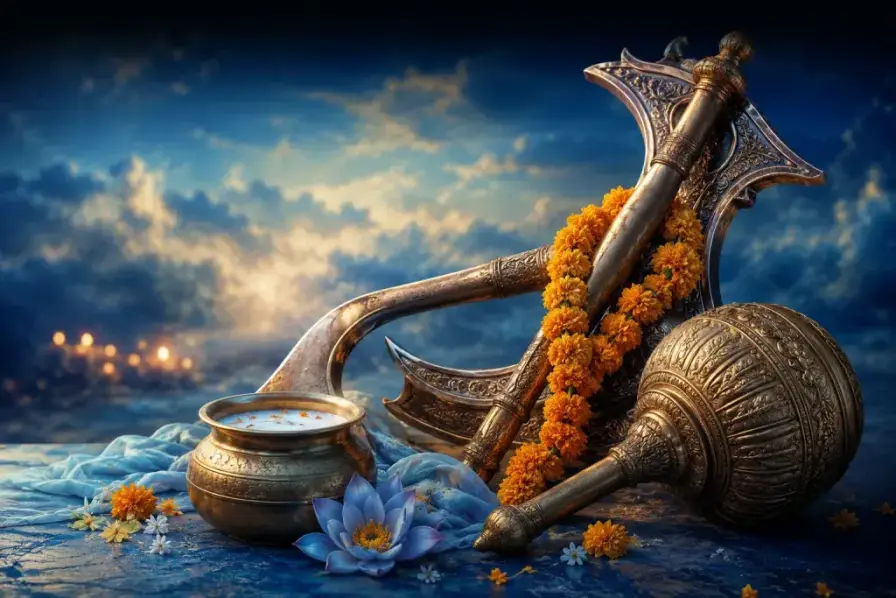
Balarama is the elder brother of Lord Krishna, and the two are almost always spoken of together. Where Krishna is the cowherd and the strategist, Balarama is the strong one — broad-shouldered, fair-skinned, and famously powerful. He is shown carrying a plough (hala) and a mace (gada), which is why he is also called Halayudha and Haladhara, "the one who bears the plough." That plough is not incidental: Balarama is closely tied to farming, the soil, and the cycle of sowing and harvest, and he is honoured as a protector of agriculture and rural life.
In the tradition Balarama is counted as a divine descent (avatar) of Vishnu, and is widely held to be an incarnation of Shesha, the great serpent on whom Vishnu rests. Like Krishna, he was born in the line of Yadavas and grew up in Gokul and Vrindavan. The childhood stories told of the two brothers — mischief, feats of strength, and the defeat of demons sent against them — are part of the same cycle, and on this day it is Balarama's part in them that is brought forward.
Balarama Jayanti falls on the sixth tithi (Shashthi) of the waning fortnight (Krishna Paksha), two days before Krishna Janmashtami. Because it follows the Hindu lunar calendar rather than the Gregorian one, the date does not stay fixed and shifts each year, usually landing in August or early September. In several parts of North India the same day is kept as Hal Shashthi (also Halshashthi or Lalahi Chhath), with its own customs built around the brother who carries the plough.
Rituals & observance
How Balarama Jayanti is kept:
- Devotees worship Balarama, often alongside Krishna, with images of the two brothers placed together and offered flowers, incense, and a lamp.
- In temples connected to Krishna — and especially in Vrindavan, Mathura, and the Braj region — the day is observed with special puja, kirtan, and readings about Balarama's life.
- Many keep a fast (vrat) through the day and break it after the evening worship, while others simply offer prayers without a full fast.
- Because Balarama is tied to the plough and the soil, the day carries an agricultural note in farming communities, who honour him as a guardian of crops and cattle.
- Where the day is kept as Hal Shashthi, mothers in parts of North India observe a vrat for the wellbeing of their children, and some traditions avoid foods grown with the plough, eating only what the land yields without ploughing.
- Offerings of milk, curd, butter, and seasonal fruit are common, in keeping with the brothers' cowherd upbringing in Braj.
Regional variations
How this date is determined
Observed on the Shashthi tithi of Bhadrapada (Shukla paksha), reckoned by midday (madhyahna).
Dates are computed to astronomical precision (NASA/JPL ephemeris), in line with traditional panchang.