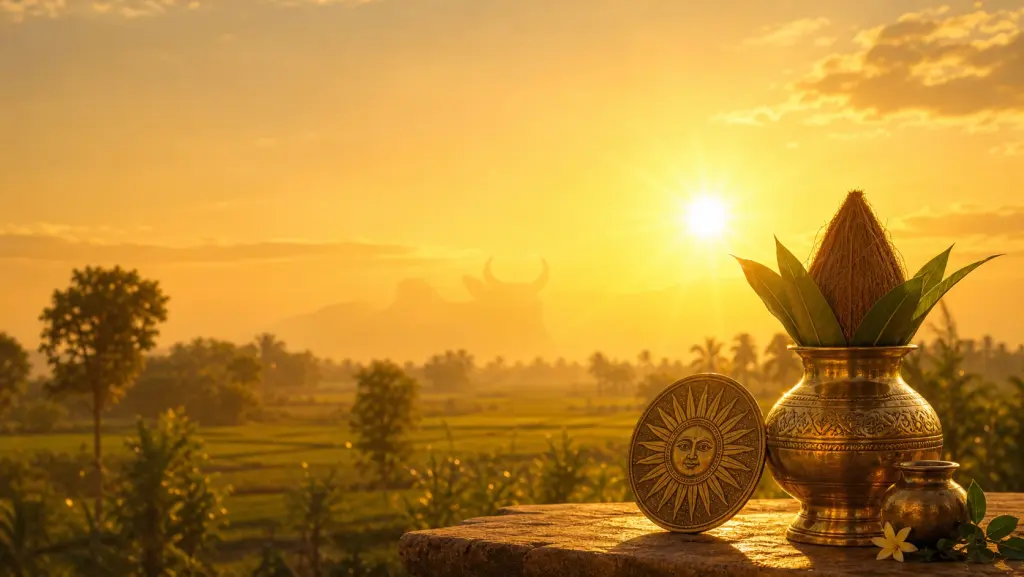
Vrishabha Sankranti
When it falls
The date shifts because it tracks the moon, not the Gregorian calendar.
Calculated for India (IST) using precise Panchang astronomy. Dates can shift by a day at locations far to the east or west.
Significance
Vrishabha Sankranti is one of the twelve solar sankrantis — the days that mark the Sun's passage from one zodiac sign into the next. Sankranti means exactly that crossing, and on this day the Sun (Surya) leaves Aries (Mesha) and enters Taurus (Vrishabha), the second sign. It is worth being clear that this is a solar event, not a lunar one: the date is set by the Sun's absolute position in the sky, not by the phase of the Moon, which is why it lands near the same calendar day in mid-May every year.
Compared with the major sankrantis — Makar Sankranti in January or Mesha Sankranti, the solar new year in April — Vrishabha Sankranti is a quiet one. There is no large harvest festival or public celebration attached to it across most of India. Its importance is mainly calendrical: in the regional solar calendars of Odisha, Bengal, Tamil Nadu and Kerala, the Sun's entry into Taurus begins a new solar month, so the day functions as a month-marker more than a festival in its own right.
What the day does carry is the standard merit attached to any sankranti. Each of these solar crossings is treated as an auspicious threshold suited to a holy bath, charity and remembrance — a small reset point in the year. Falling as it does at the start of the hottest stretch of the season in much of India, the giving associated with this sankranti often takes a seasonal form: water, shade and cooling food for those who need them.
Rituals & observance
How Vrishabha Sankranti is kept — simply, and mostly at home:
- The central observance is a holy bath (snan) at first light, in a river or sacred water-source where one is near, otherwise at home, taken during the morning punya kaal around the Sun's ingress.
- Offerings of water (arghya) are made to the rising Sun (Surya), the deity of every sankranti, as a mark of gratitude.
- Giving (daan) is the act most associated with the day. Because the sankranti falls at the onset of peak summer, the giving often takes a seasonal form — water, drinking-water pots, buttermilk, fruit, or simple meals offered to those in need.
- Many households keep a light fast or vegetarian diet for the day and avoid beginning major new ventures until the crossing is complete, treating the ingress as a clean dividing line in the month.
- In regions that follow a solar calendar — Odisha, Bengal, Tamil Nadu and Kerala — families note the day as the start of the new solar month and may visit a temple, without the larger public festivities seen at Makar or Mesha Sankranti.
Regional variations
How this date is determined
Observed on the sankranti, the day the Sun crosses into a new zodiac sign.
Dates are computed to astronomical precision (NASA/JPL ephemeris), in line with traditional panchang.