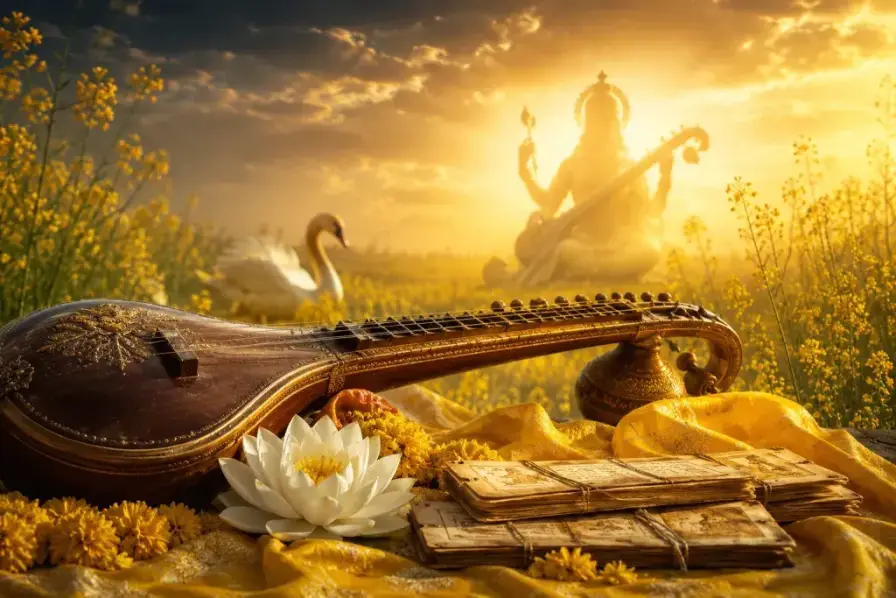
Vasant Panchami
Goddess Saraswati
When it falls
The date shifts because it tracks the moon, not the Gregorian calendar.
Calculated for India (IST) using precise Panchang astronomy. Dates can shift by a day at locations far to the east or west.
What Vasant Panchami Marks
Vasant Panchami falls on the fifth day (Panchami) of the bright fortnight (Shukla Paksha) of the lunar month of Magha, which lands in late January or February. It is read as the first day of spring (vasant), when winter starts to loosen, mustard fields turn yellow across north India, and the season of new growth begins. The festival carries that turn in the weather and in mood: lighter days, longer light, and a sense of starting fresh.
The day belongs to Saraswati, the goddess of learning, music, speech, and the arts. By tradition she is honoured here as the source of knowledge and clear expression, which is why students, teachers, writers, and musicians keep this day with particular care. Many families treat it as an auspicious time to begin something connected to learning.
One of the oldest customs of the day is Akshar-Abhyasam, or Vidya-Arambham — a child's first lesson in writing letters. A parent or elder guides the child's hand to form the first words before the goddess. It is a small ceremony, but it captures the heart of the festival: the deliberate beginning of education.
Rituals & observance
Saraswati Puja is usually done in the forenoon (purvahna), while the Panchami tithi is present. The observances are simple and centre on learning and the colour yellow, which stands for the mustard blossom and the spring sun.
- Wear yellow. People dress in yellow clothes, and many homes cook yellow food — sweet saffron rice (kesari bhaat), boondi, or dishes coloured with turmeric.
- Set up the puja. Place an image or idol of Saraswati and offer yellow flowers, often marigold or mustard blossom, along with fruit and sweets.
- Keep books and instruments before the goddess. Students place their textbooks, pens, and notebooks, and musicians and artists place their instruments and tools at her feet, leaving them unused for the day so they can be blessed.
- Begin a child's learning. Where there is a young child, elders guide the first writing of letters (Akshar-Abhyasam) as an auspicious start to education.
- Recite or read. Many families read the Saraswati Vandana or other prayers to the goddess during the forenoon puja.
- Honour the season. In some homes the day also marks the start of spring observances, with kite-flying common in parts of north India.
Regional variations
How this date is determined
Observed on the Panchami tithi of Magha (Shukla paksha), reckoned by the forenoon (purvahna). Should the tithi fall across two days, tradition keeps the earlier day (purva-viddha).
Dates are computed to astronomical precision (NASA/JPL ephemeris), in line with traditional panchang.