Varuthini Ekadashi
Lord Vishnu
When it falls
The date shifts because it tracks the moon, not the Gregorian calendar.
Calculated for India (IST) using precise Panchang astronomy. Dates can shift by a day at locations far to the east or west.
What Varuthini Ekadashi marks
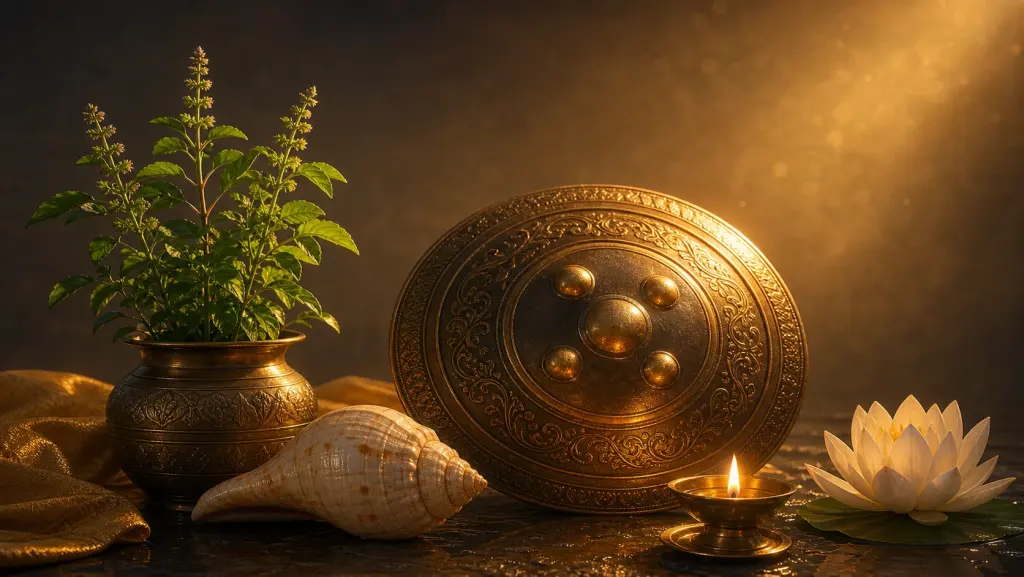
Varuthini Ekadashi is one of the twenty-four Ekadashis that fall across the lunar year — the eleventh day (tithi) of each fortnight, observed as a fast for Vishnu. This one belongs to the dark, waning fortnight (Krishna Paksha) of the lunar month Vaishakha, which falls in spring. Its name comes from varutha, meaning a shield or armor: traditional texts present this day as one that offers protection to the observer, which is the sense behind its name.
Like every Ekadashi, the heart of the day is restraint rather than ceremony. The tradition holds that the merit (punya) of a sincere fast on this tithi is considerable, and older accounts frame it as a day for letting go of indulgence and turning attention toward Vishnu through fasting, prayer, and self-discipline. The specific stories attached to it vary by text, so the safest reading is the shared one: a protective, merit-bearing fast in Vishnu's name.
Because Ekadashi recurs every lunar fortnight — once in the waxing half and once in the waning half — Varuthini is one stop in a continuing monthly rhythm rather than a single annual event. Devotees who keep all Ekadashis treat it as part of an ongoing practice; others observe the ones that hold particular meaning for them.
Rituals & observance
Observance centers on the fast itself, kept from sunrise on Ekadashi until the parana (fast-breaking) window the next morning. Practices range from a strict waterless fast to a lighter one with fruit and milk, depending on capacity and family custom.
- Fast through the day. Grains, beans, and lentils are avoided. Many keep a partial fast on fruit, milk, and water; the stricter observe nirjala (without water). Choose the level you can sustain honestly.
- Avoid rice especially. Across Ekadashi observance, rice is the food most pointedly set aside; tamasic foods, onion, and garlic are also typically left out.
- Keep the day simple and restrained. Time goes to remembering Vishnu — reciting his names, reading or hearing scripture, and visiting a temple if you can. Late-night vigil (jagran) is part of the practice for some.
- Break the fast at parana the next morning. On Dwadashi (the twelfth tithi), end the fast within the prescribed parana window — after sunrise and before the tithi ends. Breaking it too early or too late is considered improper.
- Give according to your means. Offering food, water, or alms (dana) on or around the day is a common accompaniment to the fast.
How this date is determined
Observed on the Ekadashi tithi of Vaishakha (Krishna paksha), reckoned by sunrise (udaya tithi).
Dates are computed to astronomical precision (NASA/JPL ephemeris), in line with traditional panchang.