Varalakshmi Vrat
Goddess Lakshmi
When it falls
The date shifts because it tracks the moon, not the Gregorian calendar.
Calculated for India (IST) using precise Panchang astronomy. Dates can shift by a day at locations far to the east or west.
Lakshmi worship for the welfare of the whole household
Varalakshmi means Lakshmi who grants a vara, or boon. The worship is directed not only toward money but toward the fuller idea of household prosperity: food in the home, health, children, learning, courage, reputation, peace and the ability to meet family responsibilities. This is why the observance is often explained through Ashtalakshmi, the eight forms through which Lakshmi's support is understood.
The vrat is especially prominent in Tamil Nadu, Karnataka, Andhra Pradesh, Telangana and parts of Maharashtra. It is commonly led by married women for the welfare of spouse and family, but that is a regional custom rather than a rule that makes the worship unavailable to others. Men, unmarried women and other family members may participate according to their household tradition.
The date is not simply any Friday in Shravana. It is the Friday immediately before Shravana Purnima, or the Purnima Friday itself when the full-moon tithi falls on Friday. Because the weekday and lunar tithi must be combined, the observance can fall several days before Raksha Bandhan and its Gregorian date changes from year to year.
Rituals & observance
Varalakshmi Puja is normally a household ceremony. Detailed mantras vary by family and sampradaya; a simple puja should preserve the core sequence rather than copying unfamiliar steps without guidance.
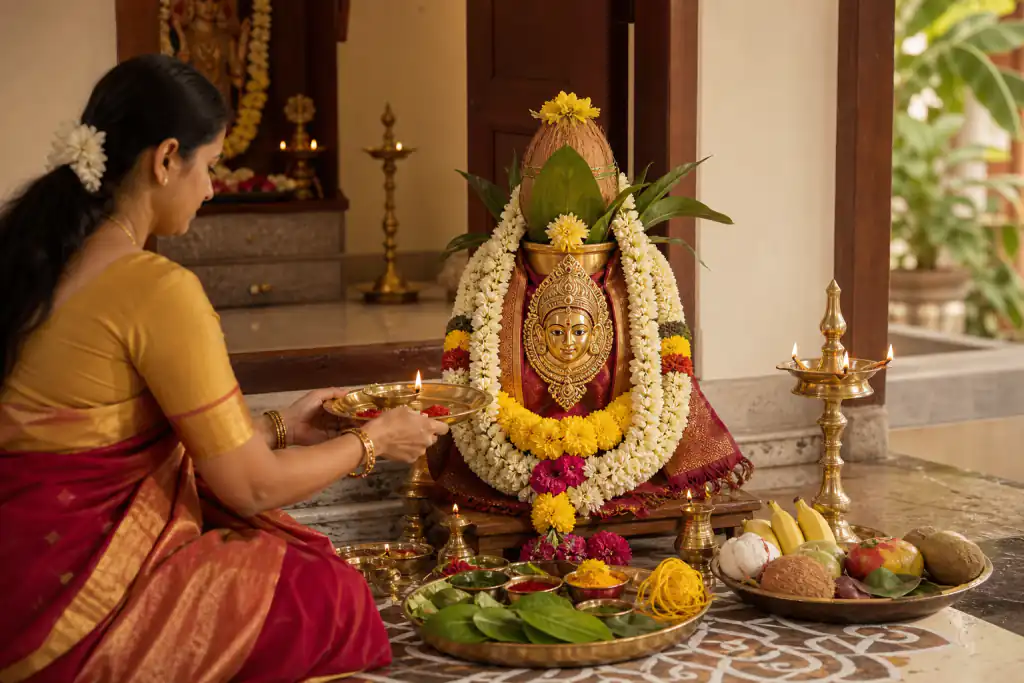
- Prepare the puja place: clean the home and draw a kolam or rangoli. Set the altar in a clean area and arrange the lamp, flowers, turmeric, kumkum, fruit, betel leaves, sweets and the family's usual Lakshmi offerings.
- Install the kalasha: fill a clean pot with water or rice according to family custom, place mango or betel leaves and a coconut above it, and decorate it with cloth, flowers and a Lakshmi face if one is traditionally used. The kalasha is treated as the presence of Vara-Lakshmi for the puja.
- Make the sankalpa: state the intention of observing Varalakshmi Vrat for the well-being of the family. Invoke Ganesha first, then worship the kalasha and Goddess Lakshmi with lamp, flowers, kumkum and naivedya.
- Offer the sacred thread: the yellow or red sacred thread, often called dorak, toram or charadu, is worshipped and then tied on the wrist according to regional custom. It is a sign of the vow, not a substitute for the puja itself.
- Offer naivedya and read the vrata katha: sweets and savoury dishes vary by region. Many households read the traditional Varalakshmi story and invite married women for kumkum, tambulam and prasad.
- Complete the observance carefully: some families keep the kalasha until the next morning and then perform a brief concluding worship before moving the water, rice and coconut into respectful household use. Follow the sequence inherited in the family when one exists.
Regional variations
How this date is determined
Observed on the full-moon day (Purnima) of Shravana (Shukla paksha), reckoned by sunrise (udaya tithi).
Dates are computed to astronomical precision (NASA/JPL ephemeris), in line with traditional panchang.