Somvati Amavasya
Dates in 2026
A monthly observance — here are its dates through this year.
Calculated for India (IST) using precise Panchang astronomy. Dates can shift by a day at locations far to the east or west.
What Somvati Amavasya means
Somvati Amavasya is the new moon (Amavasya) that falls on a Monday. The name joins two ideas: Somvar, the Hindu word for Monday (Soma is also a name for the Moon), and Amavasya, the last and darkest tithi of the waning fortnight. Because the new moon does not always land on a Monday, this day does not come every month, only a few times a year. That rarity is part of why it is held in special regard, and the pairing of Monday, a day sacred to Lord Shiva, with the new moon gives it both a Shiva and an ancestral character.
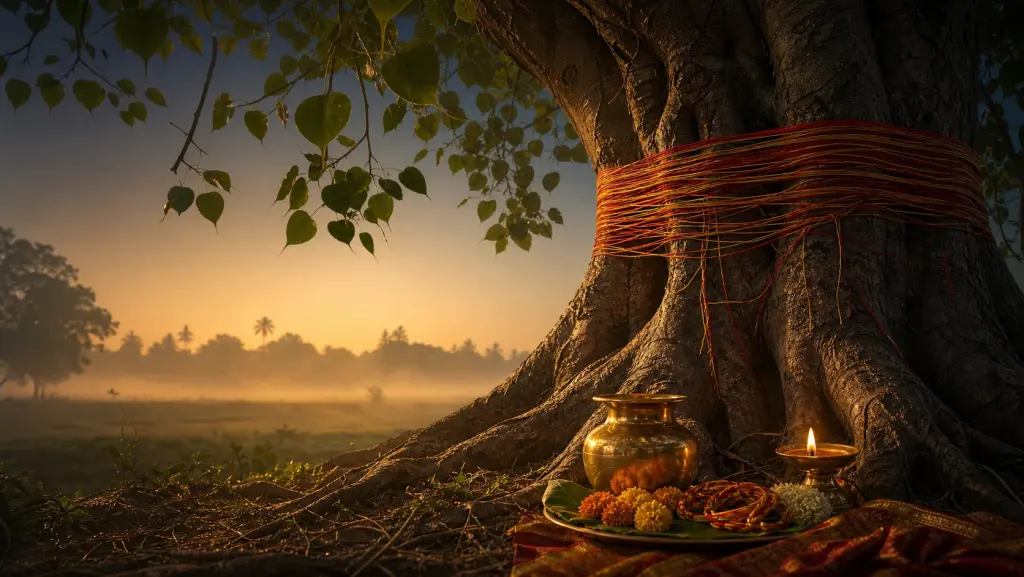
The day is held especially auspicious for married women, who keep it for the long life and wellbeing of the husband and the family. The central practice is the circumambulation (pradakshina) of a sacred tree, usually the peepal (pipal) or the banyan (vat): water is offered at the roots, a raw cotton thread is wound around the trunk as the woman circles it, and Shiva and Parvati are worshipped. In many tellings the observance is linked to the story of Savitri, whose devotion won back the life of her husband, and that ideal of steadfast devotion is woven through the day.
Because every Amavasya is also a day for the ancestors (pitru), Somvati Amavasya carries that strand too. Many families offer tarpan, water and prayers to the departed, and some bathe in a sacred river or tank where they can. So the day holds two threads together: the married woman's vrat for the family's wellbeing, and the household's remembrance of its forebears, both kept on a Monday new moon that returns only now and then.
Rituals & observance
Somvati Amavasya is a one-day observance built around tree worship, the worship of Shiva and Parvati, and offerings to the ancestors. Customs vary by family and region, but the core sequence is consistent.
- Morning bath and sankalp: devotees bathe early, in a sacred river or tank where possible, and take the resolve (sankalp) to keep the day, especially the married women observing it.
- Circling the peepal or banyan tree (pradakshina): a sacred peepal (pipal) or banyan (vat) tree is circumambulated. Water is offered at the roots and a raw cotton thread is wound around the trunk with each round.
- Worship of Shiva and Parvati: because Monday is sacred to Lord Shiva, Shiva and Parvati are worshipped, often with water, flowers, and a lamp, and prayers are offered for the family's wellbeing.
- Offerings to the ancestors (pitru tarpan): as on every Amavasya, water and prayers (tarpan) are offered to the departed, and in many homes food is set aside in their remembrance.
- Charity and the vrat katha: many give food, cloth, or alms in charity (daan), and the story of the day, often linked to Savitri's devotion, is read or recounted.
- Breaking the fast: women who keep a fast complete the tree worship and the puja first, and break the fast afterward, sharing prasad with the family.
Regional variations
How this date is determined
Observed on the new-moon day (Amavasya), reckoned by sunrise (udaya tithi).
Dates are computed to astronomical precision (NASA/JPL ephemeris), in line with traditional panchang.