Simha Sankranti
When it falls
The date shifts because it tracks the moon, not the Gregorian calendar.
Calculated for India (IST) using precise Panchang astronomy. Dates can shift by a day at locations far to the east or west.
Significance & story
Simha Sankranti is one of the twelve sankrantis — the days each year when the Sun (Surya) moves from one zodiac sign into the next. On this day it leaves Cancer and enters Leo (Simha), the sign the Sun itself rules. Because it is fixed to the Sun's actual position rather than the Moon's phases, the date stays close to the same point in mid-August every year and drifts only very slowly over centuries.
Coming in the heart of the monsoon, this is not a harvest day like the winter sankranti but a quieter solar observance. Leo is the Sun's own sign, so the ingress is treated as a fitting day to honour Surya directly — through a dawn bath, offerings of water, and giving to those in need (snan-daan). The merit of charity and bathing in flowing water on a sankranti is the thread common to all twelve, and it carries through here.
The day matters far more in some regions than others, and it anchors different local reckonings. In parts of the south it opens the auspicious Simha month and the run-up to the Onam season; in the north and west it is observed more simply as a day for Sun worship, fasting and donation. The shared idea is the same across regions: a solar threshold worth marking with a clean start, a gift given, and gratitude to the source of light.
Rituals & observance
How Simha Sankranti is kept:
- The central act is a dawn holy bath (snan) in a river or sacred water-source during the meritorious window (punya kaal) around the Sun's ingress, followed by giving (daan) — grain, clothes, or food to those in need.
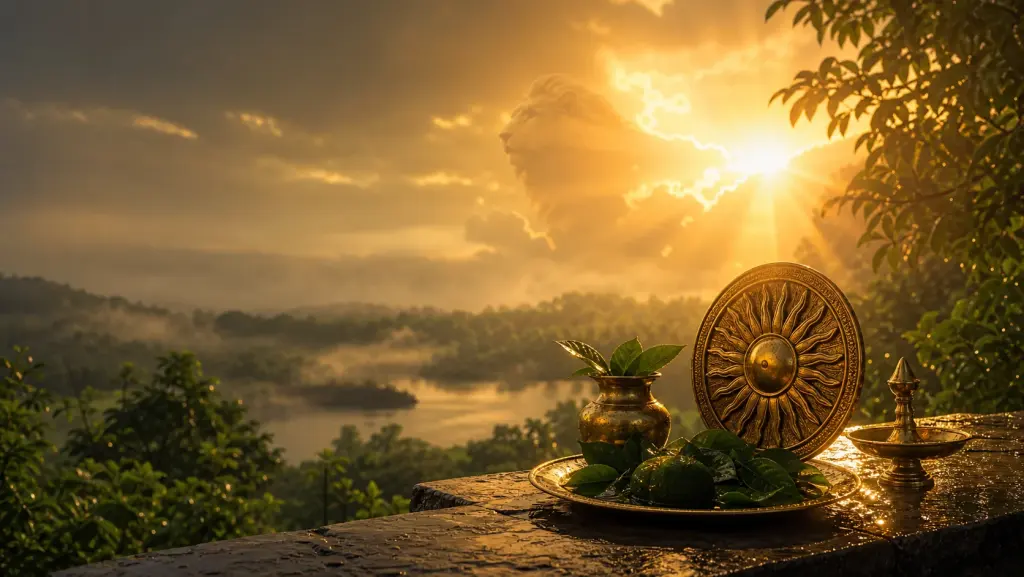
- Offerings of water (arghya) are made to the rising Sun (Surya), since the day marks his entry into Leo (Simha), his own sign — a natural day to honour him directly.
- Many keep a partial or full fast through the morning and break it after the bath and donation are done.
- In Sun temples and at home shrines, special prayers to Surya are offered, sometimes with recitation of the Aditya Hridaya or other hymns to the Sun.
- Where the day opens the Simha month, families begin the seasonal observances that lead toward Onam and other mid-year festivals, treating it as an auspicious start rather than a single day's rite.
Regional variations
How this date is determined
Observed on the sankranti, the day the Sun crosses into a new zodiac sign.
Dates are computed to astronomical precision (NASA/JPL ephemeris), in line with traditional panchang.