Sankashti Chaturthi
Lord Ganesha
Dates in 2026
A monthly observance — here are its dates through this year.
Calculated for India (IST) using precise Panchang astronomy. Dates can shift by a day at locations far to the east or west.
What Sankashti Chaturthi means
Sankashti Chaturthi falls on the fourth day (Chaturthi) of the waning fortnight (Krishna Paksha), so it comes around once every lunar month — about twelve or thirteen times a year. The name itself states the purpose: sankashti means a time of difficulty or trouble, and the day is kept to ask Lord Ganesha (Ganapati), the remover of obstacles (Vighnaharta), to clear the troubles a household is carrying. It is a steady, recurring observance rather than a single big festival, which is why many families keep it month after month.
Unlike Ganesh Chaturthi, which celebrates Ganesha's birth in the bright fortnight, Sankashti is a vrat (a fast taken as a vow). Devotees go without a full meal through the day and break the fast only at night, after they have seen the moon and offered it water. Tying the fast to moonrise is the heart of the day — the worship is not complete until the moon is sighted, and the timing changes from month to month and place to place because it depends on when the moon actually rises locally.
The day carries no fear or grand spectacle attached to it. People keep it for practical, everyday reasons — a difficult stretch at work, a family member's health, an exam or decision ahead — and treat Ganesha as the household deity who is approached first when something needs to go right. When the Chaturthi falls on a Tuesday it is called Angarki Sankashti Chaturthi, held to be especially significant and observed more widely than the others through the year.
Rituals & observance
Sankashti Chaturthi is a one-day fast that runs from morning until the moon is sighted at night. Customs vary by family and region, but the core sequence is consistent.
- A daylong fast (vrat): devotees keep a fast through the day. Some take only fruit, milk and water, while others keep a stricter fast; the form is adapted to what a person can safely manage.
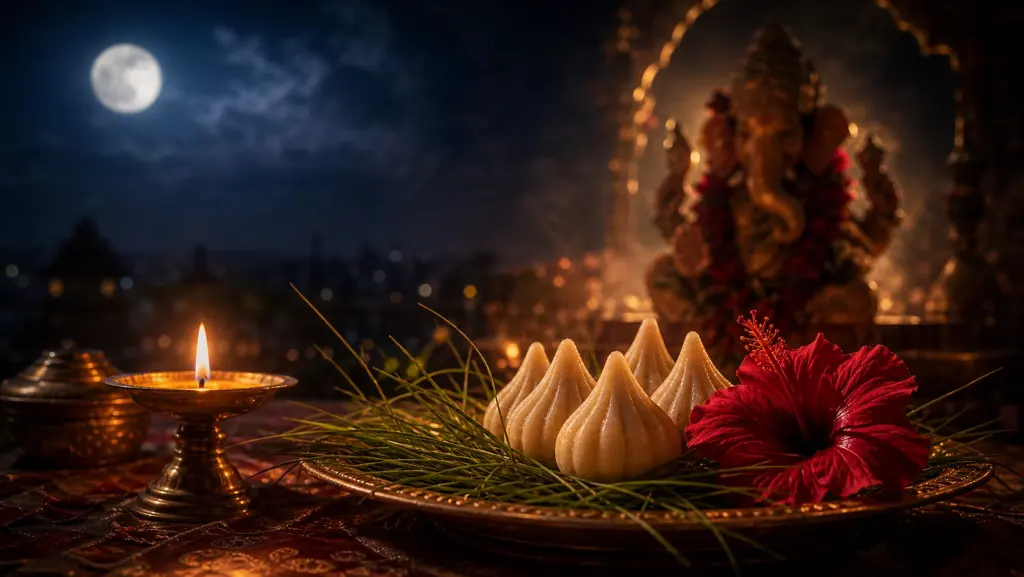
- Morning bath and Ganesha puja: after bathing, an image or idol of Ganesha is worshipped, often with red flowers, durva grass (the tender three-bladed grass offered to him), and incense.
- Offering of modak or laddu: the steamed sweet dumpling held to be Ganesha's favourite (modak), or a laddu, is offered as prasad and shared after the fast is broken.
- Reading the Sankashti story (vrat katha): many recite the day's story and chant Ganesha's names or the Sankatahara Ganapati stotra during the evening.
- Moonrise sighting and arghya: the fast is broken only after the moon is seen at night. Water is offered to the moon (arghya), prayers are completed, and the day's food is eaten afterward — so the meal depends on local moonrise, not a fixed hour.
Regional variations
How this date is determined
Observed on the Chaturthi tithi, reckoned by moonrise (chandrodaya). Should the tithi fall across two days, tradition keeps the earlier day (purva-viddha).
Dates are computed to astronomical precision (NASA/JPL ephemeris), in line with traditional panchang.