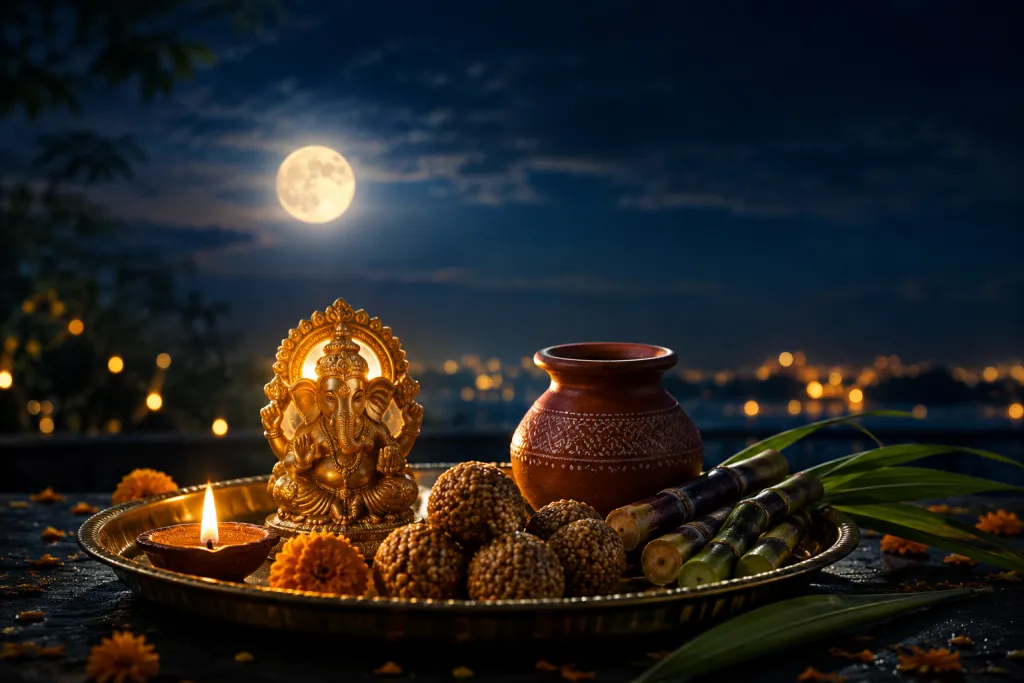
Sakat Chauth
Lord Ganesha
When it falls
The date shifts because it tracks the moon, not the Gregorian calendar.
Calculated for India (IST) using precise Panchang astronomy. Dates can shift by a day at locations far to the east or west.
Significance & story
Sakat Chauth is the Chaturthi (fourth tithi) of the dark half (Krishna paksha) of Magha, falling in January or February. Sankashti Chaturthi — the Chaturthi after the full moon — comes every lunar month and is dedicated to Lord Ganesha (Ganapati), the remover of obstacles. Of the year's twelve, the one in Magha is held to be the most important, which is why it carries its own name. 'Sankashti' means relief from difficulty, and the day is kept to ask Ganesha to clear hardship from the household.
In practice the fast is kept above all by mothers, for the long life and wellbeing of their children. This family focus is what gives the day its character: it is less a temple festival than a home vrat, observed quietly through the day and completed at night. The fast is a hard one — many keep it without food and water (nirjala) until the moon is sighted — and breaking it is tied not to a clock but to moonrise, so the day naturally runs long into the evening.
Several regional names point to the same day. In parts of North India it is Tilkuta Chauth or Til Chauth, after the sesame (til) sweets central to the offering; it is also called Maghi Chauth for its month, and Sakat Chauth or Sankat Chauth for the relief from trouble (sankat) it is meant to bring. The shared thread across all of them is Ganesha worship, a moonrise fast, and the wish to keep one's children safe and well.
Rituals & observance
How Sakat Chauth is kept:
- The observer — most often a mother — keeps a day-long fast, many without food and water (nirjala), from sunrise until the fast is broken at night after moonrise.
- Lord Ganesha is worshipped at home with a clay or turmeric image, lamps, and the recital of his story (vrat katha) for the day.
- Sweets made of sesame and jaggery (til-gud or tilkut) are prepared and offered — the offering that gives the day its name Tilkuta Chauth — often shaped into a small mound or laddu.
- The fast is not broken until the moon is sighted. Once the moon rises it is offered water (arghya) and worship, after which the food offered to Ganesha is taken as the first meal.
- Many families offer a portion to a cow or share the til sweets among children and neighbours, in keeping with the day's focus on the welfare of the young.
Regional variations
How this date is determined
Observed on the Chaturthi tithi of Magha (Krishna paksha), reckoned by moonrise (chandrodaya).
Dates are computed to astronomical precision (NASA/JPL ephemeris), in line with traditional panchang.