Republic Day
When it falls
The date shifts because it tracks the moon, not the Gregorian calendar.
Calculated for India (IST) using precise Panchang astronomy. Dates can shift by a day at locations far to the east or west.
What Republic Day commemorates
Republic Day marks 26 January 1950, the day the Constitution of India came into force and replaced the Government of India Act of 1935 as the country's governing document. With that, India completed its journey from a self-governing dominion to a fully sovereign democratic republic, with an elected head of state in place of the British monarch.
The date was chosen deliberately. On 26 January 1930, the Indian National Congress had declared 'Purna Swaraj' (complete independence) and observed that day as a pledge of self-rule. When the Constitution was ready, its framers timed its commencement to 26 January to honour that earlier declaration, linking the new republic to the freedom struggle that produced it.
It is one of India's three recognised national holidays, alongside Independence Day (15 August) and Gandhi Jayanti (2 October). The day celebrates the Constitution itself — the framework of fundamental rights, duties, and democratic institutions drafted by the Constituent Assembly under the chairmanship of the drafting committee led by Dr. B. R. Ambedkar.
Rituals & observance
Republic Day is a public holiday across India, observed with official ceremonies and community events rather than private rituals. Common observances include:
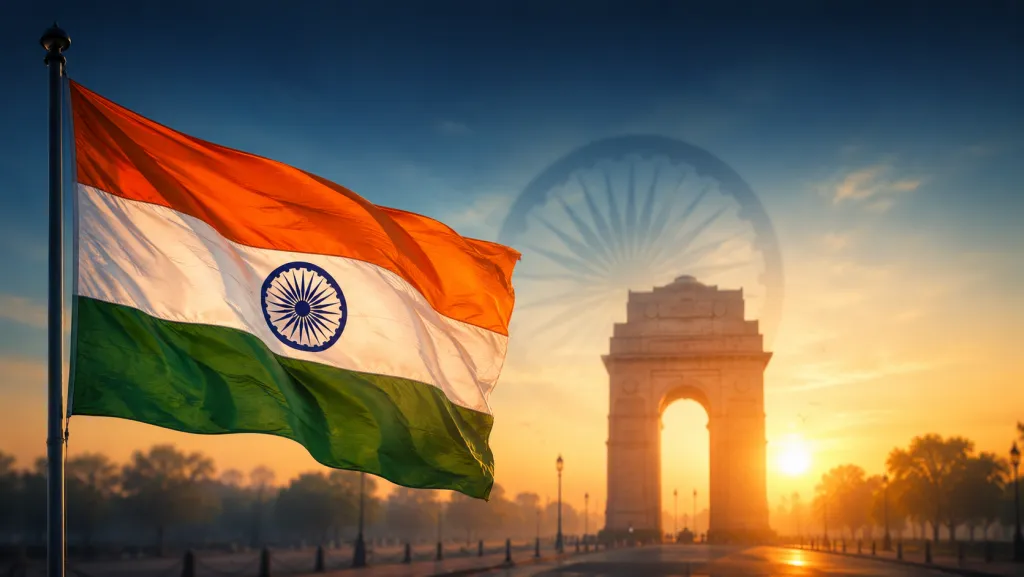
- The Republic Day parade in New Delhi, a formal procession along the ceremonial route in the capital featuring the armed forces, regional tableaux, and cultural performances, presided over by the President of India as Supreme Commander of the armed forces.
- Hoisting of the national flag by the President at the national ceremony and by dignitaries, officials, and citizens at state capitals, government offices, schools, and public institutions.
- Playing of the national anthem, 'Jana Gana Mana', and a 21-gun salute as the flag is unfurled at the main ceremony.
- Conferment of national honours and gallantry awards, traditionally announced around this period, recognising service in the armed forces, public life, and other fields.
- School and community functions with patriotic songs, speeches on the Constitution and citizens' rights and duties, and distribution of sweets.
- Live broadcast of the Delhi parade on national television and radio, watched by audiences across the country.
How this date is determined
Observed on the same fixed date in the Gregorian calendar every year.