Rang Panchami
When it falls
The date shifts because it tracks the moon, not the Gregorian calendar.
Calculated for India (IST) using precise Panchang astronomy. Dates can shift by a day at locations far to the east or west.
What Rang Panchami means
Rang Panchami falls on the fifth day (Panchami) after Holi, on Chaitra Krishna Panchami, usually in March. In much of north India the colour-play happens the morning after the Holika bonfire, but in Maharashtra, Madhya Pradesh and the Konkan the main day of colour is kept five days later, on Rang Panchami. The name says it plainly: rang means colour and panchami means the fifth tithi, so the day is the fifth-day festival of colours.
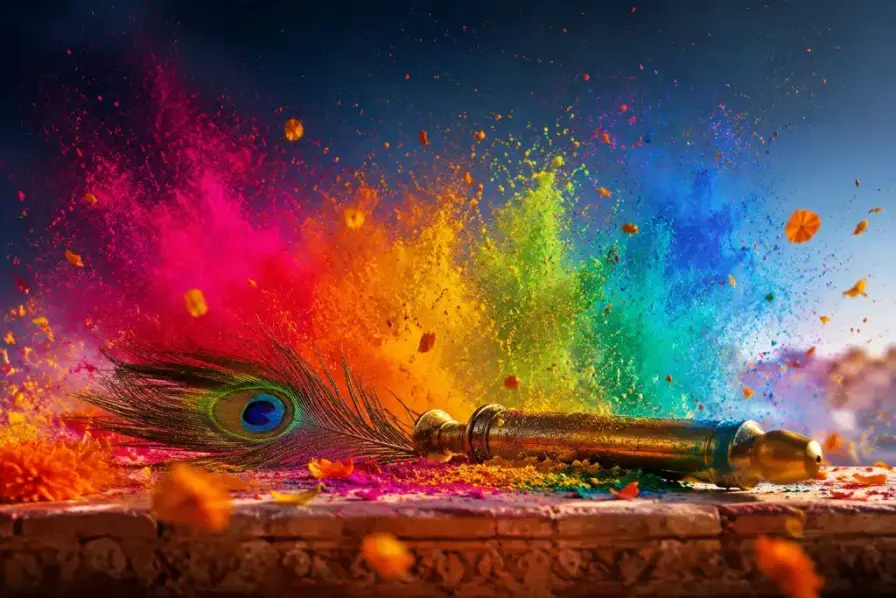
By tradition the day celebrates the colourful, playful love of Radha and Krishna. The throwing of gulal, the dry coloured powder, into the air is read as a way of carrying that playful mood into the whole community at once. In these regions the emphasis falls on colour scattered openly in streets and squares, giving the day a slightly different character from the Holi colour-play elsewhere.
Observances centre on gulal, processions, music, and community gatherings in streets and squares. In Indore the day is marked by a large and well-known Gair procession, in which crowds move through the old city amid clouds of gulal, jets of coloured water sprayed from tankers, and music. Across the region Rang Panchami is the high point of the colour celebration rather than a quiet afterthought to Holi.
Rituals & observance
Rang Panchami is a public, communal celebration of colour kept five days after Holi. Customs vary by town, but the core is the throwing of dry gulal in the open.
- Throwing dry gulal: the day's central custom is scattering dry coloured powder (gulal) into the air and onto one another, filling streets and squares with clouds of colour.
- Processions and Gair: towns hold colourful processions through the streets, the best known being the grand Gair procession in Indore, which moves through the old city amid music and colour.
- Music and dancing: drums, songs and dancing accompany the colour-play, drawing whole neighbourhoods and communities out into the open together.
- Honouring Radha and Krishna: the playful colour is offered in the spirit of the love of Radha and Krishna, and in some places their worship and bhajans accompany the day.
- Community gatherings and sweets: families and neighbours come together, sharing festive sweets and food once the colour-play winds down, carrying the warmth of the season.
Regional variations
How this date is determined
Observed on the Panchami tithi of Chaitra (Krishna paksha), reckoned by sunrise (udaya tithi).
Dates are computed to astronomical precision (NASA/JPL ephemeris), in line with traditional panchang.