Purnima Vrat
Lord Vishnu
Dates in 2026
A monthly observance — here are its dates through this year.
Calculated for India (IST) using precise Panchang astronomy. Dates can shift by a day at locations far to the east or west.
Why the Full-Moon Fast Matters
Purnima is the full-moon day (purnima) of the Hindu lunar month, and a fast (vrat) kept on it is a regular monthly observance rather than a once-a-year festival. The day is associated chiefly with Lord Vishnu, and many keep the fast as a simple, recurring act of devotion — a fixed point in the month set aside for prayer, restraint from food, and giving to others.
The full moon also carries the Moon (Chandra) at its brightest and fullest, and in tradition the mind is closely tied to the Moon. Keeping a fast and a calm, devotional day on Purnima is seen as a way to steady the mind and clear it of agitation, which is one reason the observance recurs every month rather than being tied to a single story.
Each month's full moon has its own character, and several fall on famous named festivals — for example the Ashadha full moon is Guru Purnima, honouring teachers and the sage Vyasa. The monthly Purnima Vrat is the everyday version of the same lunar day: the named celebrations are layered on top of it, but the fast, the worship of Vishnu, and the charity remain the common thread in every month.
Rituals & observance
Observance is straightforward and varies by family. The common elements are a day-long fast, worship of Lord Vishnu, and giving in charity, with the puja usually done in the evening once the moon is up.
- Keep a fast for the day. Many take only fruit, milk, and water; some keep a stricter waterless (nirjala) fast, while elders and those who are unwell take a lighter form.
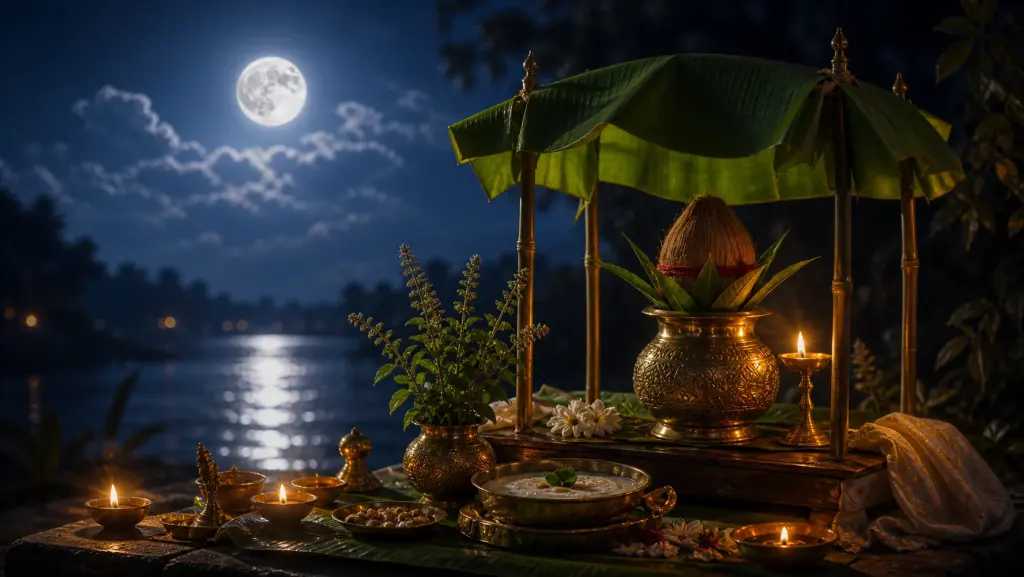
- Bathe and worship Lord Vishnu at home, offering flowers, tulsi leaves, fruit, and a lamp, and reciting his names or a short prayer.
- Many households perform the Satyanarayan Puja on this day and read the accompanying story (katha), which is closely linked with the full moon.
- Offer respect to the Moon (Chandra) once it has risen, and break the fast after seeing the full moon or after the evening puja.
- Give in charity — food, clothes, or money to those in need, or food offered to a temple or to others keeping the vrat — which is considered especially fitting on this day.
- Share the offered food (prasad) with family and visitors after the puja.
How this date is determined
Observed on the full-moon day (Purnima), reckoned by sunrise (udaya tithi).
Dates are computed to astronomical precision (NASA/JPL ephemeris), in line with traditional panchang.