Bail Pola
When it falls
The date shifts because it tracks the moon, not the Gregorian calendar.
Calculated for India (IST) using precise Panchang astronomy. Dates can shift by a day at locations far to the east or west.
What Bail Pola means
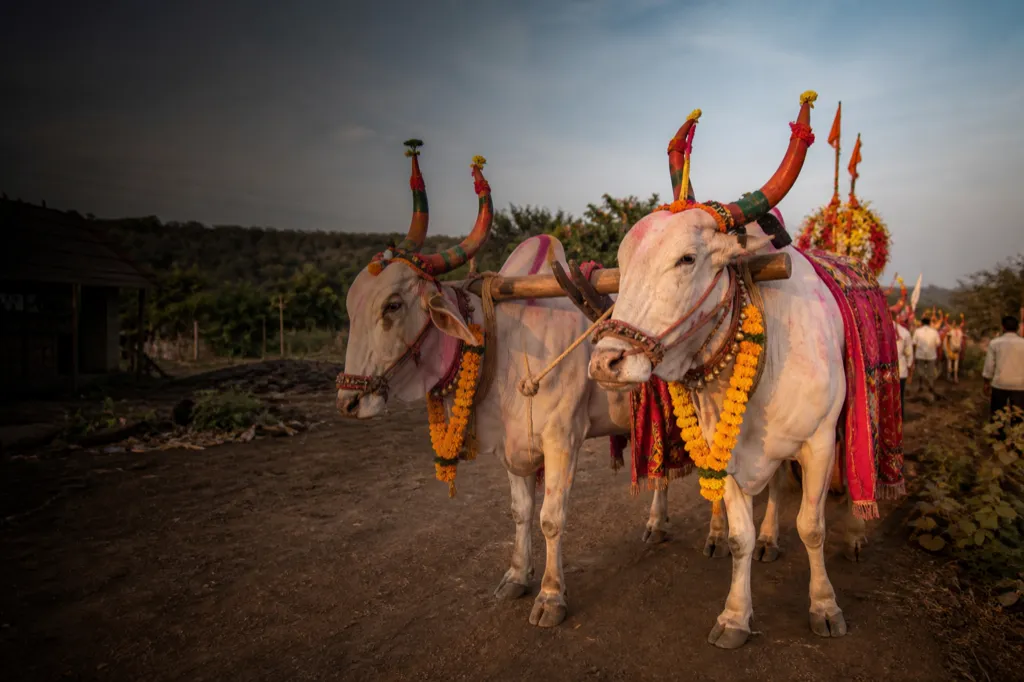
Bail Pola is Maharashtra's festival of gratitude to the bullocks and oxen that sustain agricultural work. The animals that draw the plough and cart are released from labour for the day, cared for, decorated, and brought into the centre of household and village worship. The respect is practical as well as devotional: the festival recognises their year-round contribution to the farm.
Pola falls on Shravan Amavasya in the Amanta calendar, usually in August or September. The same lunar day is also associated with Pithori Amavasya, a family vrata concerned with the wellbeing of children. The observances can share a date without becoming the same ritual: Pola centres the farm's working cattle, while Pithori worship follows its own household tradition.
The day is especially visible in rural communities. Bullocks are washed, sometimes given an oil rub, fitted with fresh ropes and bells, dressed in decorated cloth, and taken through the village with music. Children may join with decorated wooden or clay bulls, carrying the agrarian tradition into homes that no longer keep working cattle.
Rituals & observance
Pola customs centre on rest, care, gratitude, and public honour for the farm's working animals.
- A day free from work: bullocks are not yoked for ploughing or cart work; rest is the first honour given to them.
- Bathing and grooming: the animals are washed and groomed, and some families give them an oil massage before decoration.
- Painting and decorating: horns are painted, old ropes may be replaced, bells and garlands are added, and decorated cloth is placed across the back.
- Aarti and special food: families apply the customary marks, perform aarti, and feed the bullocks festival food in thanks for their labour.
- Village and children's processions: decorated bullocks are led through the village with music, while children may carry or parade small wooden or clay bulls.
Regional variations
How this date is determined
Observed on the new-moon day (Amavasya) of Bhadrapada (Krishna paksha), reckoned by the afternoon (aparahna). Should the tithi fall across two days, tradition keeps the day with the greater overlap (adhika-vyapti).
Dates are computed to astronomical precision (NASA/JPL ephemeris), in line with traditional panchang.