Parashurama Jayanti
Lord Parashurama
When it falls
The date shifts because it tracks the moon, not the Gregorian calendar.
Calculated for India (IST) using precise Panchang astronomy. Dates can shift by a day at locations far to the east or west.
Why Parashurama Jayanti is observed
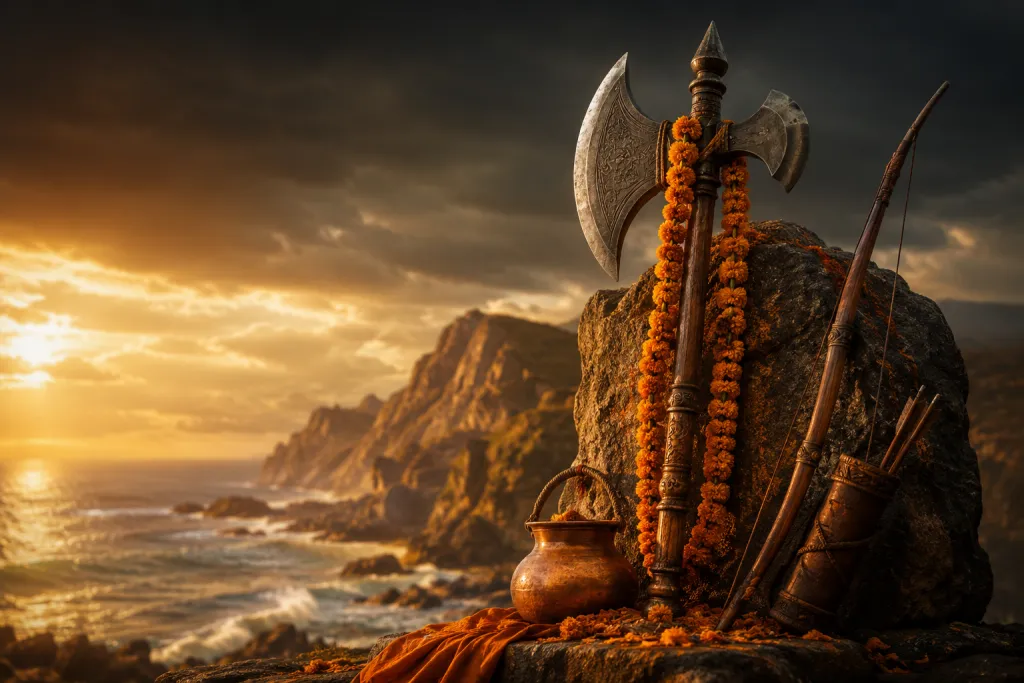
Parashurama Jayanti celebrates the birth of Lord Parashurama, counted as the sixth of the ten principal avatars (dashavatara) of Lord Vishnu. He was born to the sage Jamadagni and his wife Renuka, and is unusual among the avatars for being a Brahmin who lived as a warrior. His name comes from the parashu, the axe gifted to him by Lord Shiva, which he carries in most depictions.
The stories told on this day centre on righteousness defended by force when persuasion fails. The best known is his conflict with the king Kartavirya Arjuna, also called Sahasrarjuna, whose family wronged the sage Jamadagni; Parashurama is remembered for restoring order against rulers who abused their power. He is also counted among the chiranjivis, the deathless figures of tradition believed to remain present across the ages, which is why he appears in both the Ramayana and the Mahabharata.
The day falls on the third day (tritiya) of the bright fortnight of Vaishakha, usually in April or May, and shares this tithi with Akshaya Tritiya. Because Akshaya Tritiya is regarded as a day when good deeds carry lasting merit, worship and charity offered on Parashurama Jayanti are seen as especially worthwhile. The emphasis through the day is on discipline, courage, and standing firm for what is right rather than on elaborate ritual.
Rituals & observance
Observance is quieter than the larger festivals and centres on fasting, worship, and remembering Parashurama's life from early morning. Common practices include:
- Keeping a fast (vrat) for the day as a mark of discipline, with many devotees taking only fruit and milk and breaking the fast after evening worship.
- Bathing early and visiting a Vishnu or Parashurama temple for darshan and the morning aarti, where havan (a sacred fire offering) may also be performed.
- Reading or listening to accounts of Parashurama's life and his role in the Ramayana and Mahabharata, often in group gatherings.
- Holding bhajans and kirtans in temples and homes, recounting his deeds and devotion.
- Offering charity (daan) on the day, which is considered especially meritorious because the tithi coincides with Akshaya Tritiya.
Regional variations
How this date is determined
Observed on the Tritiya tithi of Vaishakha (Shukla paksha), reckoned by dusk (pradosh kala).
Dates are computed to astronomical precision (NASA/JPL ephemeris), in line with traditional panchang.