Papankusha Ekadashi
Lord Vishnu
When it falls
The date shifts because it tracks the moon, not the Gregorian calendar.
Calculated for India (IST) using precise Panchang astronomy. Dates can shift by a day at locations far to the east or west.
What Papankusha Ekadashi commemorates
Like every Ekadashi, this is one of the twenty-four (sometimes twenty-six) eleventh-day observances that fall twice each lunar month, once in the waxing fortnight and once in the waning. Papankusha Ekadashi is the Shukla Paksha (bright, waxing fortnight) Ekadashi of the month of Ashwin, and like all of them it is dedicated to Vishnu. Here he is honoured especially in his Padmanabha form, the deity from whose navel the lotus of creation is said to rise.
The name itself carries the day's purpose. Papa means wrongdoing or accumulated fault, and ankusha is the hooked goad used to guide an elephant. Together they give the sense of a discipline that reins in and clears past misdeeds. Traditional accounts, including those associated with the Padma Purana, frame the vrat as a means of release from the burden of one's own actions, with merit said to extend to one's forebears as well.
The promise attached to this Ekadashi in the tradition is generous, but the spirit behind it is simple and practical: a fixed day each fortnight set aside for restraint, devotion, and a pause from ordinary appetites. Its importance is real but moderate within the wider festival year, sitting among the regular monthly Ekadashis rather than the grand annual festivals.
Rituals & observance
The observance follows the familiar pattern of an Ekadashi vrat. The core of it is the fast itself, kept from the previous evening or from sunrise on the Ekadashi until the fast is formally broken the next morning.
- Fast (upavasa) on the Ekadashi. Many keep a full fast without food or water (nirjala); others take a single light, grain-free meal (phalahar) of fruit, milk, nuts, or permitted vegetables.
- Avoid grains, rice, lentils (pulses), and beans for the day. These are traditionally set aside on every Ekadashi; the meal, if taken, uses fruit and non-grain foods instead.
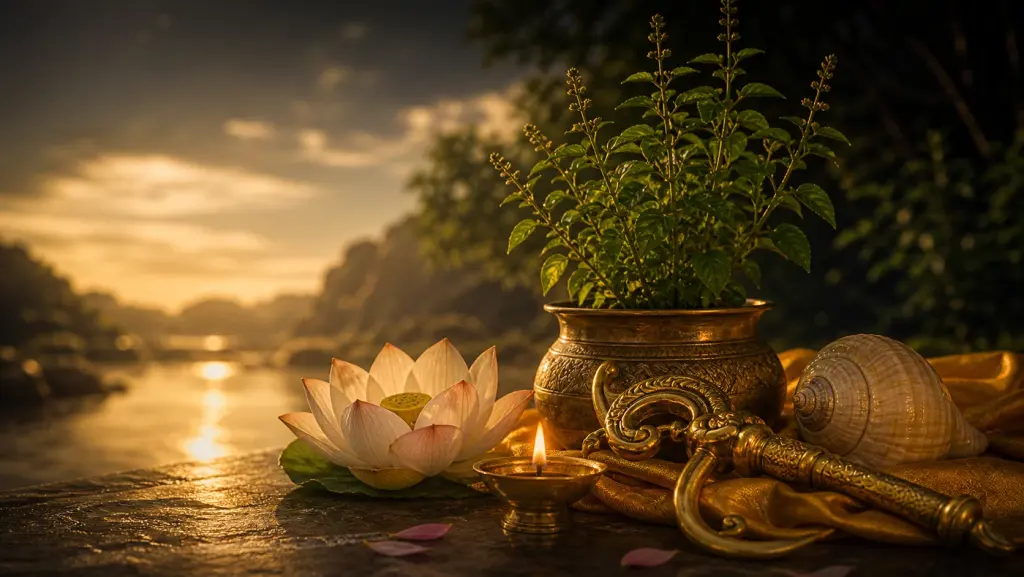
- Worship Vishnu through the day, often with offerings of tulsi (holy basil) leaves, a lamp, flowers, and recitation or reading from the Vishnu Sahasranama or related texts.
- Keep a quiet, restrained day — minimal sleep, simple conduct, and time given to prayer and reflection rather than indulgence.
- Break the fast (parana) the next morning within the prescribed window on Dwadashi, the twelfth day. Parana is done after sunrise and before the Dwadashi tithi ends; food, often grain, is taken to formally conclude the vrat.
- Donating food or simple necessities (dana) is a customary part of the observance, especially around the time of breaking the fast.
How this date is determined
Observed on the Ekadashi tithi of Ashwin (Shukla paksha), reckoned by sunrise (udaya tithi).
Dates are computed to astronomical precision (NASA/JPL ephemeris), in line with traditional panchang.