Padmini Ekadashi
Lord Vishnu
When it falls
The date shifts because it tracks the moon, not the Gregorian calendar.
Calculated for India (IST) using precise Panchang astronomy. Dates can shift by a day at locations far to the east or west.
Why Padmini Ekadashi matters
Every lunar fortnight has an Ekadashi, the eleventh day (tithi) sacred to Vishnu and kept as a fasting vrat. Padmini Ekadashi is the one that falls in the bright fortnight (Shukla Paksha) of an extra month (Adhik Maas), the leap month the Hindu calendar inserts roughly every three years to keep the lunar and solar years aligned. Because that month is itself extra, this Ekadashi appears only in those years, which is why it is regarded as especially worth keeping.
The extra month is dedicated to Vishnu under the name Purushottam, and the Ekadashis within it carry that weight. Tradition holds that the fast frees the observer from accumulated wrongdoing and is counted as a meritorious act of devotion. Its rarity is part of the point: an opportunity that does not return every year is treated as one not to be let pass.
Like all Ekadashis, the day is less about elaborate ceremony than about restraint and remembrance. The fast, the avoidance of grains, and time given to Vishnu are the substance of the observance.
Rituals & observance
The observance is a quiet day of fasting and worship rather than public celebration. Most households keep it like other Ekadashis, with these common steps:
- Begin the fast on Ekadashi, ideally after a wash at dawn, and set the intention (sankalpa) to keep the vrat for Vishnu.
- Avoid all grains, rice, lentils, and beans for the day. Many keep a strict waterless fast (nirjala); others take a single meal of fruit, milk, and non-grain foods (phalahar) depending on their capacity.
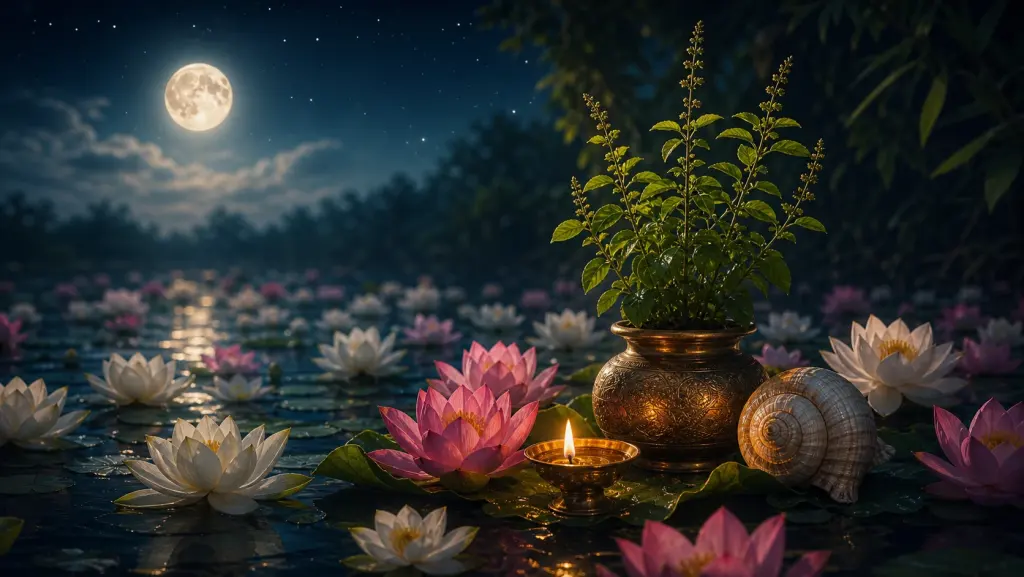
- Worship Vishnu at home or at the temple with a lamp, tulsi leaves, and flowers, and read or listen to his names and stories.
- Spend the day in restraint, keeping to truthful, calm conduct and giving time to prayer or charity rather than indulgence.
- Some devotees keep a night vigil (jagran) on the eve of Ekadashi, staying awake in remembrance of Vishnu.
- Break the fast the next morning during the parana window, after sunrise, by first taking food that includes grains.
How this date is determined
Observed on the Ekadashi tithi, reckoned by sunrise (udaya tithi).
Dates are computed to astronomical precision (NASA/JPL ephemeris), in line with traditional panchang.