Mithuna Sankranti
When it falls
The date shifts because it tracks the moon, not the Gregorian calendar.
Calculated for India (IST) using precise Panchang astronomy. Dates can shift by a day at locations far to the east or west.
Significance & story
Mithuna Sankranti is one of the twelve solar Sankrantis — the days that mark the Sun's (Surya) passage from one zodiac sign into the next. On this day the Sun leaves Taurus and enters Gemini (Mithuna). Because the date is set by the Sun's actual position rather than a Moon phase, it does not swing across the calendar the way lunar festivals do; it lands in mid-June every year and shifts only very slowly over long stretches of time.
Its timing matters more than its scale. The Sun's move into Gemini falls just as the southwest monsoon reaches much of eastern and central India, so the day is woven into the start of the agricultural year — the point when the first heavy rains soften the soil and sowing can begin. For this reason the most prominent observance attached to it is regional and earth-centred rather than pan-Indian, and the wider importance of the day is modest compared with the larger Sankrantis like Makar Sankranti.
In Odisha the ingress opens Raja Parba, a three-day festival built on the idea that the earth (Bhudevi) is readying herself for the coming planting. Around the same window, the Ambubachi observance at the Kamakhya temple in Assam keeps a closely related theme. In both, fieldwork is paused as a mark of respect for the soil before the season of cultivation begins. Elsewhere the day passes more quietly, kept mainly through the usual Sankranti acts of bathing and giving.
Rituals & observance
How Mithuna Sankranti is observed:
- As with every solar Sankranti, the day's core acts are a holy bath (snan) in a river or sacred water-source at first light, followed by giving (daan) — grain, food, water or summer essentials to those in need — during the punya kaal around the Sun's ingress.
- Offerings of water (arghya) are made to the Sun (Surya), with prayers of thanks for the season's turn and the rains that follow.
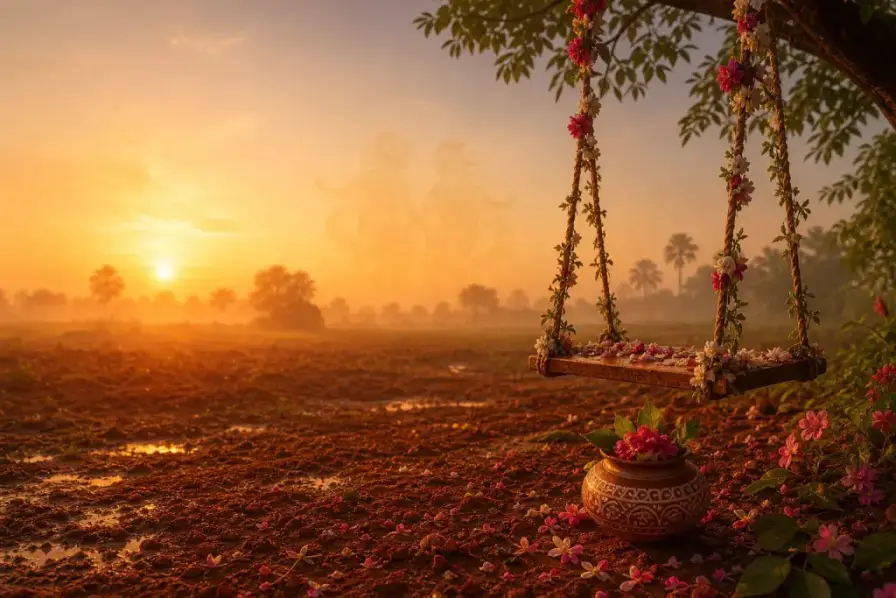
- In Odisha the day opens Raja Parba: farmwork and tilling are set aside, swings are hung from trees, and households prepare the festival cake poda pitha — a custom centred on rest for the earth before the planting season.
- Where the day marks the agricultural new start, families offer simple prayers for a good monsoon and a healthy crop before the sowing season begins.
- Beyond the specific regional festivals, many households keep the day simply — a morning bath, a quiet act of charity, and avoiding the start of major new ventures until the ingress window has passed.
Regional variations
How this date is determined
Observed on the sankranti, the day the Sun crosses into a new zodiac sign.
Dates are computed to astronomical precision (NASA/JPL ephemeris), in line with traditional panchang.