Meena Sankranti
When it falls
The date shifts because it tracks the moon, not the Gregorian calendar.
Calculated for India (IST) using precise Panchang astronomy. Dates can shift by a day at locations far to the east or west.
Significance & story
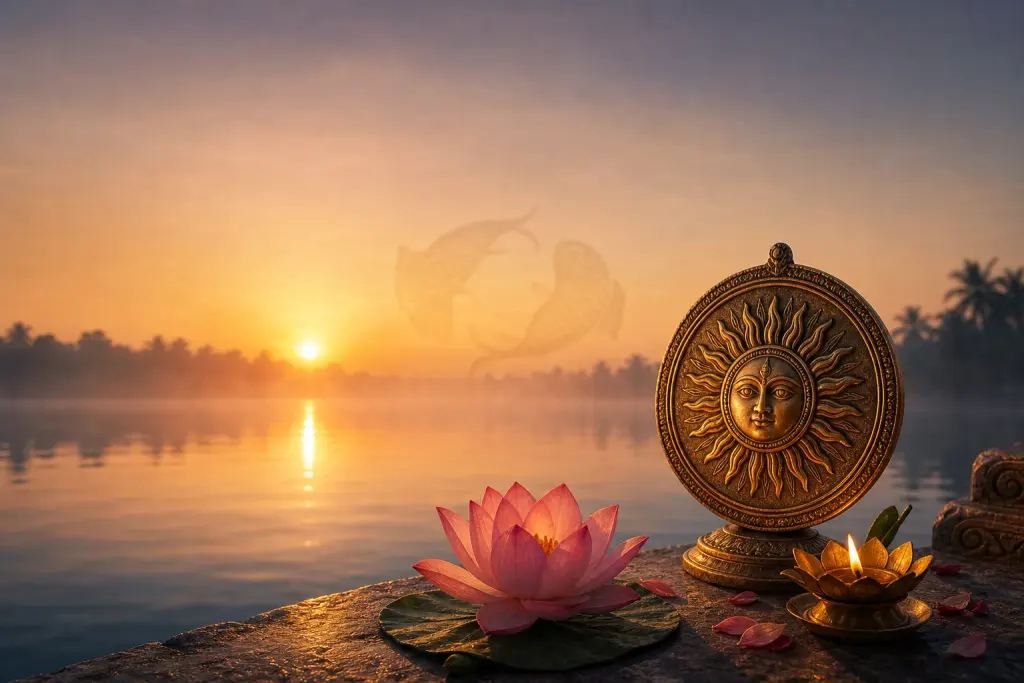
A sankranti is the Sun's passage from one zodiac sign into the next. On Meena Sankranti the Sun (Surya) enters Pisces (Meena), the twelfth and last sign of the zodiac, completing its year-long round before it crosses into Aries again a month later. Because it is fixed to the Sun's position rather than to a phase of the Moon, the date holds steady in mid-March year after year, drifting forward only very slowly over centuries.
Of the twelve sankrantis, Meena is one of the quieter ones — there is no large public festival, no harvest feast, and no fixed national holiday attached to it. What it shares with every sankranti is the idea of a threshold. The moment the Sun changes sign is treated as a sandhi, a join between two periods, and such joins are traditionally set aside for a bath, prayer and giving rather than for new ventures. Important new work is usually begun after the change settles, not in the transition itself.
In the calendars of eastern India, especially Odisha and parts of Bengal, the day the Sun enters a new sign is observed as Sankranti in its own right and kept with a temple visit, a simple offering, and gifts to those in need. Meena Sankranti is also linked in many traditions to the close of the inauspicious Kharmas (Malamas) stretch, after which weddings and other auspicious functions can resume — a sense of one phase ending and ordinary life starting again.
Rituals & observance
How Meena Sankranti is kept — simply, and mostly at home or at a temple:
- The central act is a holy bath (snan) at dawn, in a river or sacred water-source where possible, or at home, taken during the morning punya kaal around the Sun's ingress.
- Offering water (arghya) to the rising Sun (Surya), often with a few sesame seeds, as a gesture of thanks at the turn of the sign.
- Giving (daan) to those in need — grain, sesame, a meal, or whatever one can manage — which is the observance most associated with any sankranti.
- A visit to a temple, particularly to Surya or Vishnu, with a simple offering rather than elaborate worship.
- Where the day marks the end of the Kharmas (Malamas) period, families take it as the point from which weddings and other auspicious functions may be planned again.
Regional variations
How this date is determined
Observed on the sankranti, the day the Sun crosses into a new zodiac sign.
Dates are computed to astronomical precision (NASA/JPL ephemeris), in line with traditional panchang.