Masik Durgashtami
Goddess Durga
Dates in 2026
A monthly observance — here are its dates through this year.
Calculated for India (IST) using precise Panchang astronomy. Dates can shift by a day at locations far to the east or west.
What Masik Durgashtami means
Masik Durgashtami falls on the eighth day (Ashtami) of the bright fortnight (Shukla Paksha), so it comes around once every lunar month, about twelve or thirteen times a year. The name joins two ideas: masik, meaning monthly, and the Ashtami tithi on which Goddess Durga is honoured. Durga is the warrior form of the Divine Mother (Shakti), worshipped as the strength that overcomes evil and protects her devotees. The day is a vrat (a fast taken as a vow) rather than a festival of feasting, and many devotees keep it month after month.
Because the Ashtami of the waxing fortnight carries a steady, auspicious character, the tone of Masik Durgashtami is devotional and quiet rather than grand. The worship is kept by day: a fast through the daylight hours, Durga puja at home or at a Devi temple, and recitation of texts such as the Durga Saptashati or the Durga Chalisa. Some households include kanya elements, honouring young girls as living forms of the Goddess, though this is fuller during Navratri. Devotees turn to the day for protection, inner strength, and relief from difficulty, treating Durga as the Mother who shields the home.
Goddess Durga is honoured on this same Shukla Paksha Ashtami every month, but the one that falls during Sharad Navratri (around September or October) is held as the principal occasion and is observed as the grand Durga Ashtami or Maha Ashtami, the high point of the nine nights. The monthly Masik Durgashtami is the quieter, recurring form of the same devotion, kept at home and at the temple without the larger gathering and ceremony that mark the Navratri Ashtami.
Rituals & observance
Masik Durgashtami is a one-day vrat whose worship is kept by day and completed in the evening. Customs vary by family and region, but the core sequence is consistent.
- A daylong fast (vrat): devotees keep a fast through the day, which many break only after the evening worship is complete. The form is adapted to what a person can safely manage, from a fruit-and-milk fast to a stricter one.
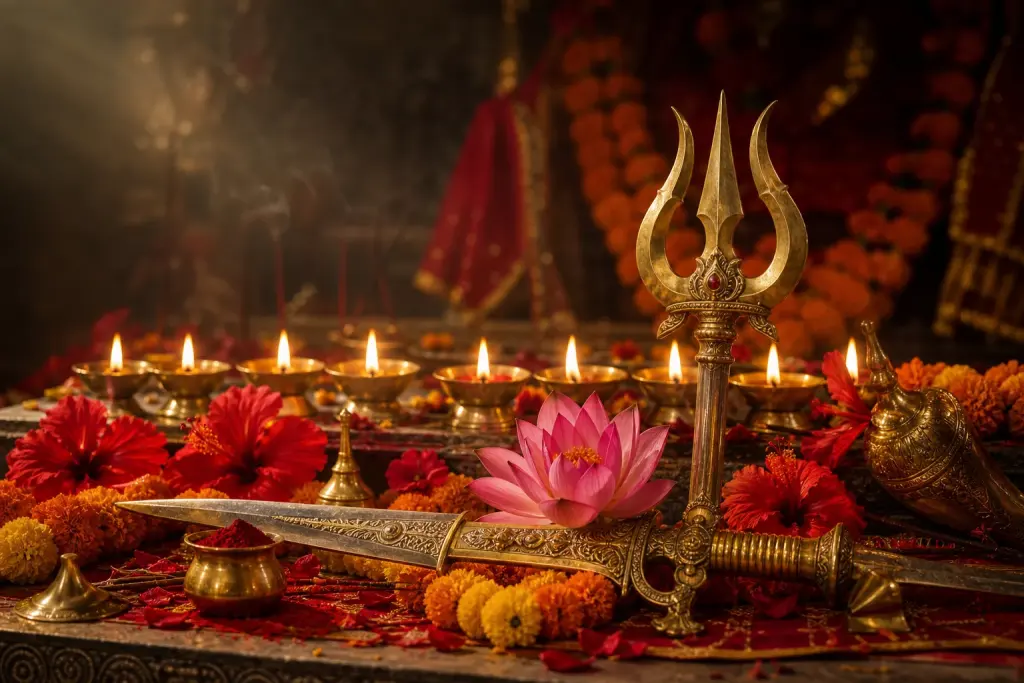
- Morning bath and Durga puja: after bathing, an image or idol of Durga is worshipped, often with red flowers, kumkum, incense, and a lamp lit before the Goddess.
- Reciting the Durga Saptashati or Durga Chalisa: devotees read the Durga Saptashati (the seven hundred verses praising the Goddess) or the shorter Durga Chalisa, along with her names and other prayers.
- Offerings to the Goddess: red flowers, sindoor, fruit, and sweets are offered, and in many homes a lamp is kept burning through the worship.
- Kanya honouring (optional): some households honour young girls as living forms of the Goddess (kanya), offering them food and gifts, a custom that is observed more fully during Navratri.
- Evening aarti and breaking the fast: the day's worship is completed with the evening aarti, after which the fast is broken and prasad is shared with the family.
Regional variations
How this date is determined
Observed on the Ashtami tithi, reckoned by sunrise (udaya tithi).
Dates are computed to astronomical precision (NASA/JPL ephemeris), in line with traditional panchang.