Mangala Gauri
Goddess Gauri (Parvati)
Dates in 2027
A monthly observance — here are its dates through this year.
Calculated for India (IST) using precise Panchang astronomy. Dates can shift by a day at locations far to the east or west.
What Mangala Gauri Vrat means
Mangala Gauri Vrat is kept on the Tuesdays (Mangalvar) of the month of Shravan, the holiest month of the year for Shiva and Parvati. The name joins two ideas: Mangala, from Mangalvar (Tuesday), and Gauri, the gentle, auspicious form of Goddess Parvati. The vrat is traditionally kept by newly married women, often through the first five years of marriage, and in many families a married woman keeps it for her own home before passing the custom on.
The purpose of the day is marital happiness in its fullest sense: a contented married life, the blessing of children, and the long life of the husband. Gauri, who won Shiva himself through her devotion and tapas, is the natural deity for this prayer, and the women who keep the vrat seek her grace for their own married lives. The day is observed by fasting through the daylight hours and completing a careful puja, after which the women gather and the fast is broken.
Because it falls in Shravan, when the worship of Shiva and Parvati is at its height, the Mangala Gauri Vrat sits within a wider season of devotion. It is especially associated with Maharashtra and the wider west of India, where the gathering of married women, the exchange of haldi-kunku (turmeric and vermilion), and the singing and storytelling make the day as much a social occasion among women as a private vow.
Rituals & observance
Mangala Gauri Vrat is a one-day fast kept on each Tuesday of Shravan, built around the puja of Gauri and a gathering of married women. Customs vary by family and region, but the core sequence is consistent.
- A daylong fast (vrat): the women keep a fast through the day, which is broken only after the evening worship is complete. The form is adapted to what a person can safely manage.
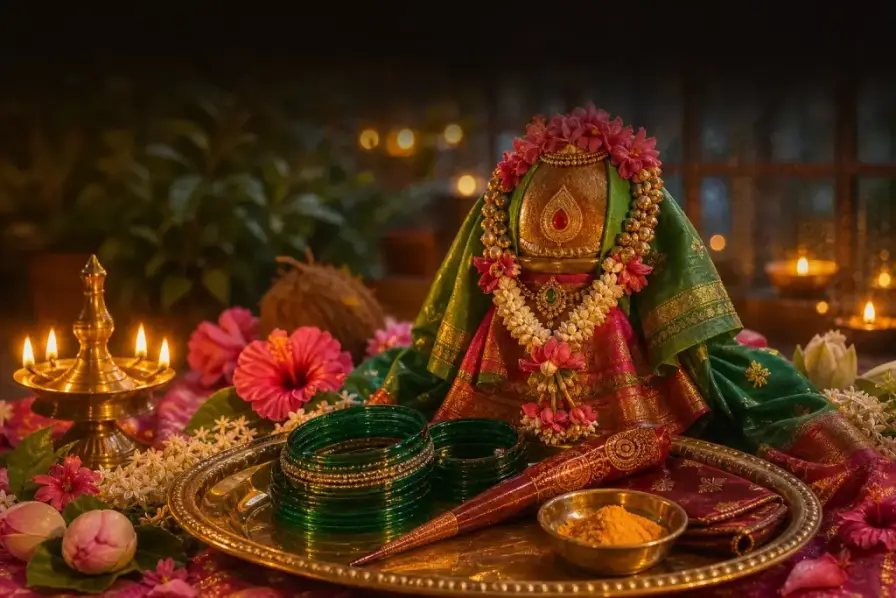
- Morning bath and Gauri puja: after bathing, an image or idol of Gauri (Parvati) is set up and worshipped, traditionally with sixteen items (the shodashopachara) offered to the Goddess.
- Offerings of sixteen items: flowers, fruit, vermilion, bangles, and other auspicious items are offered in sets of sixteen, a number associated with the married woman's good fortune (saubhagya).
- Haldi-kunku among women: married women exchange haldi-kunku (turmeric and vermilion) as a mark of mutual blessing and the wish for a long, happy married life.
- The Mangala Gauri vrat katha and aarti: the story of the vrat is read or recounted, and the day's worship is completed with the aarti to Gauri.
- Gathering and breaking the fast: married women gather for the worship and the singing, and the fast is broken after the puja, with prasad shared among those present.
Regional variations
How this date is determined
Set by the lunar calendar, reckoned by sunrise (udaya tithi).
Dates are computed to astronomical precision (NASA/JPL ephemeris), in line with traditional panchang.