Maharashtrian Bendur
When it falls
The date shifts because it tracks the moon, not the Gregorian calendar.
Calculated for India (IST) using precise Panchang astronomy. Dates can shift by a day at locations far to the east or west.
What Bendur means
Bendur is a bullock-honouring festival of western Maharashtra, kept above all in the districts of Kolhapur, Sangli, and Solapur. It falls in the bright fortnight of Ashadha, on the day on which the Mula nakshatra prevails, near the close of the Shukla Paksha, usually in June or July. The day sets aside the farm's working animals to be thanked, and it reflects the close bond between the farmer and the bullocks that draw the plough and the cart.
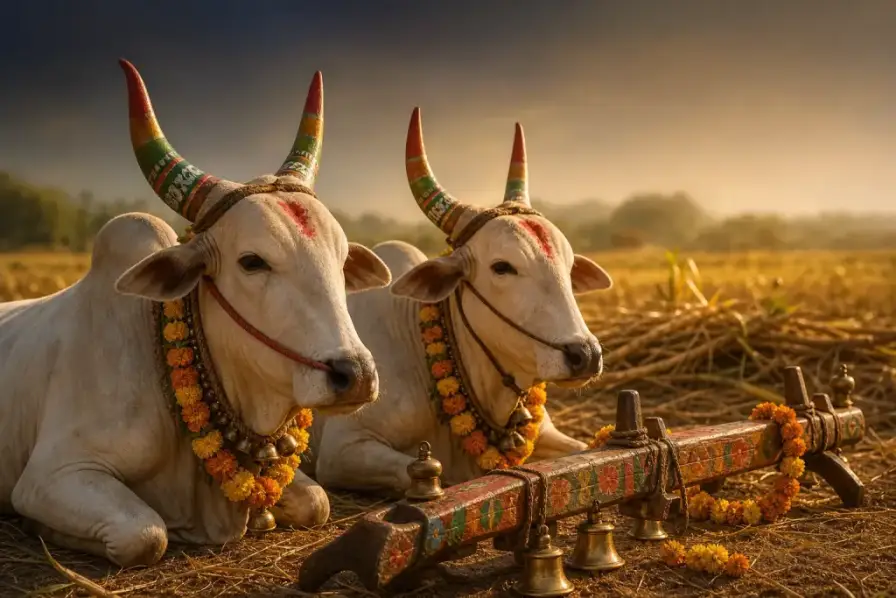
On Bendur the farm bullocks (oxen) are given a full day of rest and honour. They are bathed and cleaned, their horns painted and decorated with bells, ribbons, and flowers, and they are garlanded and freed from all work for the day. The family worships them with aarti and feeds them special food, such as puran poli, the sweet flatbread otherwise made for people on festival days. The gesture is one of gratitude: the animals that carry the heaviest burden of the field are, for a day, treated as honoured members of the household.
Bendur is the western-Maharashtra counterpart of the bull-honouring tradition, kept on its own day and distinct from Pola, which is observed elsewhere in Maharashtra on a different occasion. In the evening the decorated bullocks are led in procession through the village, a public display of the well-kept animals that is as much a point of pride for the farmer as it is an act of thanksgiving.
Rituals & observance
Bendur is a day of rest and honour for the farm's bullocks, kept in the home and the village. The customs centre on cleaning, decorating, and thanking the animals.
- Bathing the bullocks: the oxen are bathed and cleaned in the morning, in preparation for the day's honour, and freed from all work.
- Painting and decorating: their horns are painted and decorated with bells, ribbons, and flowers, and the animals are garlanded for the day.
- Aarti and worship: the family worships the bullocks with aarti, honouring them for the labour they carry in the fields through the year.
- Feeding special food: the animals are fed special festival food, such as puran poli, the sweet flatbread otherwise made for people on festival days.
- The village procession: in the evening the decorated bullocks are led in procession through the village, a public display of the well-kept animals and a point of pride for the farmer.
Regional variations
How this date is determined
with the Moon in the 19 nakshatra, reckoned by sunrise (udaya tithi).
Dates are computed to astronomical precision (NASA/JPL ephemeris), in line with traditional panchang.