Lalita Panchami
Goddess Lalita
When it falls
The date shifts because it tracks the moon, not the Gregorian calendar.
Calculated for India (IST) using precise Panchang astronomy. Dates can shift by a day at locations far to the east or west.
Significance & story
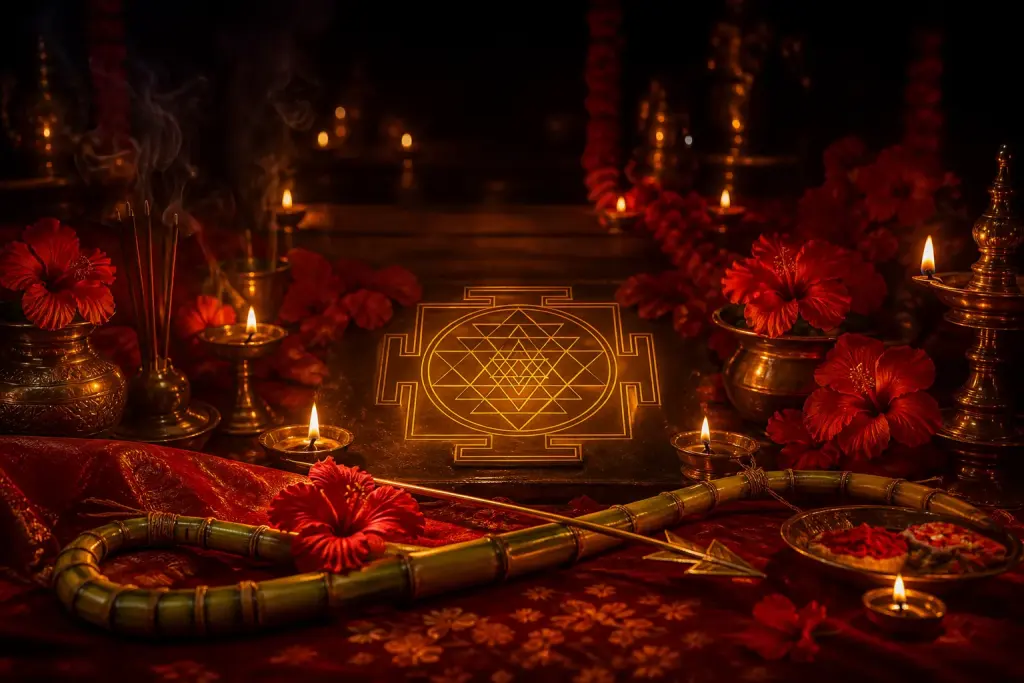
Lalita Panchami honours Goddess Lalita, worshipped in full as Lalita Tripura Sundari, the benevolent and supreme form of the Devi in the Shakta and Sri Vidya traditions. Her name carries her nature: Lalita means the one who plays or who is graceful and gentle, and she is invoked as a kind, motherly form of the great Goddess rather than a fierce one. In Sri Vidya she is the deity worshipped through the Sri Yantra, the geometric diagram regarded as her very form.
The day falls on the fifth tithi of the bright fortnight (Shukla Paksha Panchami) in the month of Ashwin, which places it on the fifth day of Sharad Navratri, the autumn nine-night worship of the Goddess. Because Navratri is given over to the Devi in her many forms, Lalita Panchami fits naturally within it as the occasion to honour her gentle, sovereign aspect. In Maharashtra the day is kept as the Upang Lalita Vrat, a fast taken as a vow in her name.
The observance is quiet and devotional rather than a large public festival, which is why it is held to be of modest importance in the wider calendar. It is observed mainly in Maharashtra and Gujarat, and also in parts of north and east India, by households and devotees drawn to the Goddess in this form. The focus is on worship at home or before her image, recitation of her praises, and the keeping of the fast, all within the larger frame of the Navratri days.
Rituals & observance
Observance is gentle and devotional, centred on the worship of Goddess Lalita within the Navratri days. Common practices include:
- Keeping the vrat: many devotees fast through the day, and in Maharashtra the day is observed as the Upang Lalita Vrat, a fast taken as a vow in the Goddess's name.
- Worship of Lalita Devi: the Goddess is worshipped before her image or picture, and in the Sri Vidya tradition before the Sri Yantra, which is regarded as her form.
- Offering flowers and a lamp: fresh flowers, a lit lamp, and other simple offerings are placed before the deity, with the worship kept clean and unhurried.
- Reciting the Lalita Sahasranama: the Lalita Sahasranama, the thousand names of the Goddess, is recited as the central act of devotion, often alongside other hymns to the Devi.
- Worship within Sharad Navratri: the day is kept as part of the wider nine-night Navratri worship, so the puja sits within the household's ongoing observance of the Goddess.
- Breaking the fast: those who keep the vrat complete the worship and then break the fast, sharing the offered food as prasad among the family.
Regional variations
How this date is determined
Observed on the Panchami tithi of Ashwin (Shukla paksha), reckoned by sunrise (udaya tithi).
Dates are computed to astronomical precision (NASA/JPL ephemeris), in line with traditional panchang.