Kanya Sankranti
When it falls
The date shifts because it tracks the moon, not the Gregorian calendar.
Calculated for India (IST) using precise Panchang astronomy. Dates can shift by a day at locations far to the east or west.
Significance & story
Kanya Sankranti is a solar festival, not a lunar one. Sankranti is the Sun's passage from one zodiac sign into the next, and on this day the Sun (Surya) leaves Leo (Simha) and enters Virgo (Kanya), the sixth sign. This opens the sixth month of the solar calendar — Kanni in the Malayalam reckoning, Aswin in much of the east — so it works as a quiet new-month marker as much as a single day's observance.
It falls in the southward half of the Sun's year (Dakshinayana), the stretch from the summer turn to the winter one. This is traditionally the season for remembering ancestors and for steady, dutiful effort rather than new beginnings, and Kanya Sankranti usually sits close to or within Pitru Paksha, the fortnight set aside for ancestral offerings. That timing colours the day: the emphasis is on a clean bath, charity, and remembrance more than on celebration.
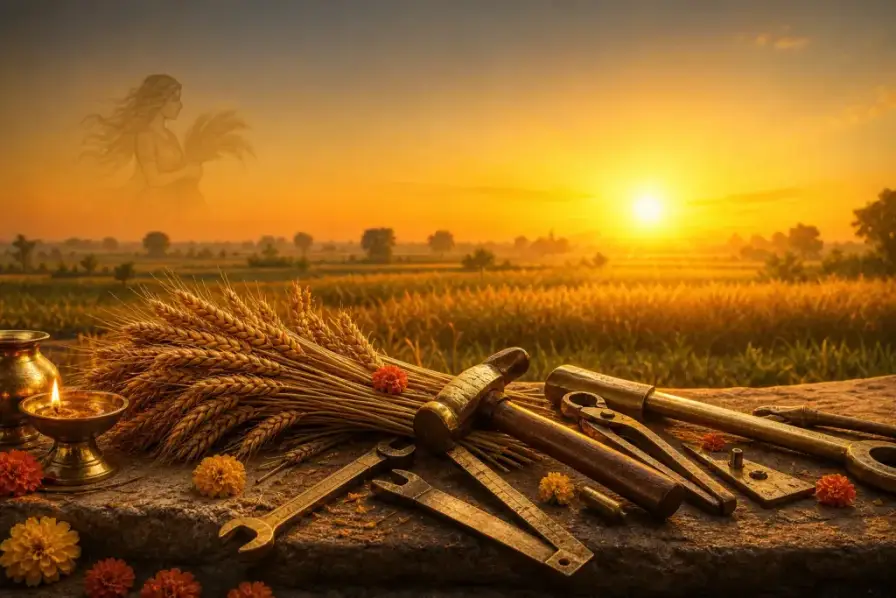
The day's best-known association is with work itself. In Bengal, Bihar, Odisha, Jharkhand, Assam and Tripura, Kanya Sankranti is the day of Vishwakarma Puja, when Vishwakarma — the divine architect and craftsman — is honoured in factories, workshops, garages and offices. Tools and machines are cleaned and worshipped, which fits the practical, settling-in mood of a sankranti that opens a working month rather than a holiday.
Rituals & observance
How Kanya Sankranti is kept:
- The core observance is a holy bath (snan) at first light in a river or sacred water-source, followed by giving (daan) — food, grain, clothing or money to those in need — during the morning punya kaal, the meritorious window around the Sun's ingress.
- Offerings of water (arghya) are made to the rising Sun (Surya) as a mark of gratitude, often the simplest rite of the day in homes that do not keep a larger observance.
- Because the day usually falls in or near Pitru Paksha, many families combine it with offerings for ancestors (tarpan or shraddha), treating the bath and giving as acts done in their memory.
- In eastern India the day is Vishwakarma Puja: tools, machines and vehicles are cleaned and worshipped in workshops, factories and offices, with prayers for safe and steady work in the year ahead.
- In Kerala the Sun's entry into Kanya opens the month of Kanni, a time when temples and homes mark the agricultural season — the harvest mood of late monsoon settling into a working calendar.
Regional variations
How this date is determined
Observed on the sankranti, the day the Sun crosses into a new zodiac sign.
Dates are computed to astronomical precision (NASA/JPL ephemeris), in line with traditional panchang.