Kamika Ekadashi
Lord Vishnu
When it falls
The date shifts because it tracks the moon, not the Gregorian calendar.
Calculated for India (IST) using precise Panchang astronomy. Dates can shift by a day at locations far to the east or west.
What Kamika Ekadashi marks
Kamika Ekadashi is one of the two Ekadashis that fall every lunar month, this one in the dark fortnight (Krishna Paksha) of Shravana, the first month of the monsoon. Like all Ekadashis it is dedicated to Vishnu, but each has its own name and emphasis. The traditional texts associate Kamika Ekadashi with the clearing of accumulated faults and wrongdoings, which is why it is kept by people who want to begin the rainy-season months with a clean slate.
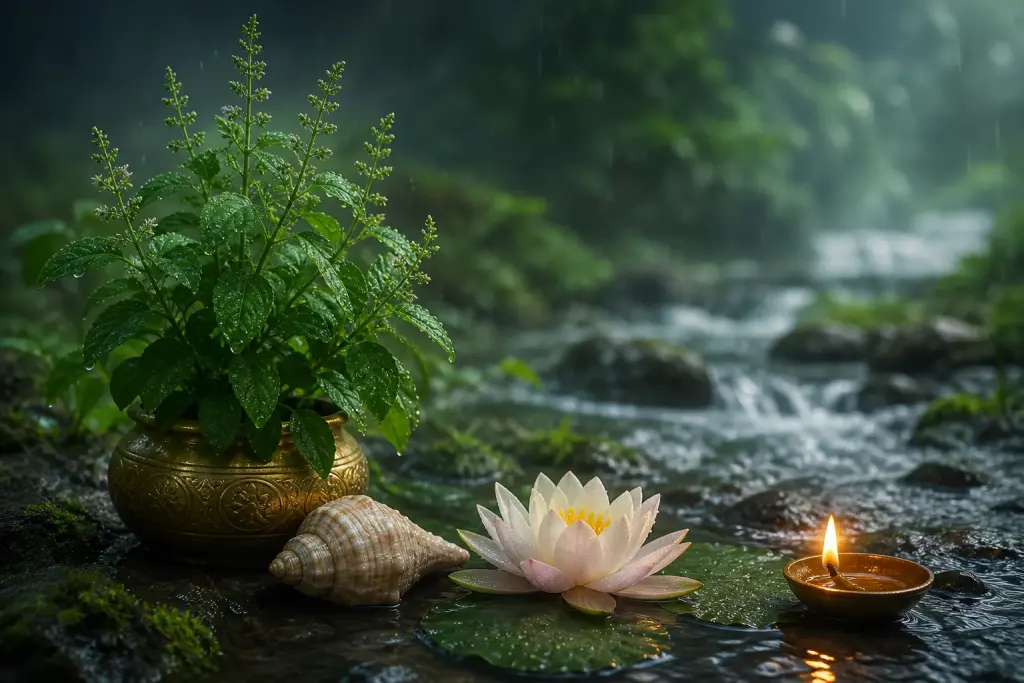
It arrives soon after Devshayani Ekadashi, the day on which Vishnu is said to begin his four-month rest (chaturmas). Through this period devotional fasts carry added weight in popular practice, and Kamika Ekadashi is the first monthly Ekadashi to fall within it. Worship on this day centres on offering tulsi (holy basil) leaves to Vishnu, considered especially dear to him.
Ekadashi is a recurring observance, not a once-a-year festival. There are roughly twenty-four across the year, two each lunar month, and committed devotees keep all of them; others choose specific ones such as this. The fast is the practice, and the particular name simply tells you which fortnight and which traditional merit it carries.
Rituals & observance
The day is built around a fast and worship of Vishnu, followed by parana the next morning. How strictly people observe it varies; the common shape is this:
- Keep a fast through the day. The strict form (nirjala) takes no food or water; the more common form (phalahar) allows fruit, milk, and non-grain foods, while grains, rice, lentils, and beans are avoided.
- Bathe and offer worship to Vishnu, traditionally with tulsi leaves, along with a lamp, incense, and flowers. Some keep a lamp burning before the deity through the evening.
- Read or listen to the Kamika Ekadashi story (vrat katha) and Vishnu's names; many spend the day in restraint, avoiding gossip, anger, and indulgence rather than only watching the food.
- Stay awake or keep the evening in devotion where the tradition is followed strictly; otherwise rest is fine and the fast itself is the main observance.
- Break the fast (parana) the next morning, on Dwadashi, within the prescribed window after sunrise, by eating grain-based food again. Breaking it too early or too late is traditionally discouraged.
How this date is determined
Observed on the Ekadashi tithi of Shravana (Krishna paksha), reckoned by sunrise (udaya tithi).
Dates are computed to astronomical precision (NASA/JPL ephemeris), in line with traditional panchang.