Kalashtami
Kala Bhairav
Dates in 2026
A monthly observance — here are its dates through this year.
Calculated for India (IST) using precise Panchang astronomy. Dates can shift by a day at locations far to the east or west.
What Kalashtami means
Kalashtami falls on the eighth day (Ashtami) of the waning fortnight (Krishna Paksha), so it comes around once every lunar month, about twelve or thirteen times a year. The name joins two ideas: Kala, meaning time (and the dark), and the Ashtami tithi on which Kala Bhairav is honoured. Bhairava is the fierce, guardian form of Lord Shiva, worshipped as the lord of time and the protector who guards against fear and danger. The day is a vrat (a fast taken as a vow) rather than a festival of feasting, and many devotees keep it month after month.
Unlike the calm, meditative Shiva, Kala Bhairav is stern and protective, so the tone of Kalashtami is serious and focused. The worship is kept mainly after sunset, because this fierce form is held to be most fittingly honoured in the evening and night. Devotees fast through the day, visit a Bhairava or Shiva temple for the night aarti, and in many places keep a vigil with chanting. People turn to the day for practical reasons: protection from harm, relief from fear or a difficult stretch, and the steadying sense of being watched over.
Kala Bhairav is honoured on this same Krishna Paksha Ashtami every month, but the one that falls in the month of Margashirsha (around November or December) is held as the principal occasion and is observed as Kalabhairav Jayanti, his appearance day. The monthly Kalashtami is the quieter, recurring form of the same devotion, kept at home and at the temple without the larger gathering that marks the Jayanti.
Rituals & observance
Kalashtami is a one-day vrat whose worship centres on the evening and night. Customs vary by family and region, but the core sequence is consistent.
- A daylong fast (vrat): devotees keep a fast through the day, which many break only after the evening or night worship is complete. The form is adapted to what a person can safely manage, from a fruit-and-milk fast to a stricter one.
- Evening temple visit and night aarti: the main worship is done after sunset, with a visit to a Kala Bhairav or Shiva temple for darshan and the night aarti.
- Reciting the Kalabhairava Ashtakam: the eight-verse hymn of praise traditionally attributed to Adi Shankaracharya is recited, along with other prayers to Shiva.
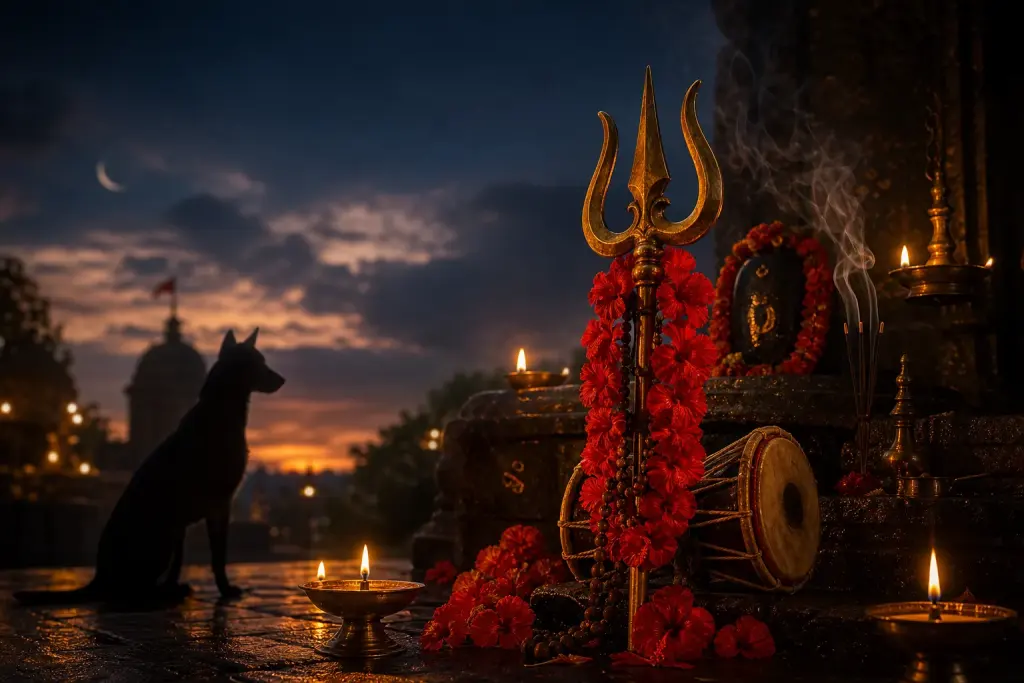
- Offerings for the fierce form: a lamp lit with mustard or sesame oil, black sesame, and flowers are placed before the deity in the evening.
- Honouring dogs: the dog is regarded as the mount (vahana) of Kala Bhairav, so many devotees feed and care for dogs on this day, often with milk, sweets, or food set aside for them.
Regional variations
How this date is determined
Observed on the Ashtami tithi, reckoned by dusk (pradosh kala).
Dates are computed to astronomical precision (NASA/JPL ephemeris), in line with traditional panchang.