Kalabhairav Jayanti
Kalabhairava (Shiva)
When it falls
The date shifts because it tracks the moon, not the Gregorian calendar.
Calculated for India (IST) using precise Panchang astronomy. Dates can shift by a day at locations far to the east or west.
Significance & story
Kalabhairav Jayanti celebrates the appearance of Kalabhairava, a fierce form (Bhairava) of Lord Shiva. He is worshipped as a guardian deity and as the lord who governs time itself, which is what the name carries: Kala means time, and Bhairava is the formidable, awe-inspiring aspect of Shiva. Unlike the calm, meditative Shiva, this form is stern and protective, invoked for guarding against fear, danger, and harm.
The best-known story tells how Kalabhairava came into being. When Brahma, the creator, grew proud and overstepped, Shiva manifested in his Bhairava form to humble that pride. The episode left Bhairava bearing the weight of a grave act, and he wandered until he reached Kashi (Varanasi), where the burden was lifted. From then he is honoured as the kotwal, the guardian, of that holy city, and tradition holds that no pilgrimage to Kashi is complete without seeking his darshan. The story is read less as a tale of punishment and more as a lesson about ego and accountability.
The day falls on the Krishna Paksha Ashtami of Margashirsha, usually in November or December, and the worship is kept mainly after sunset rather than in daylight. Because he is a fierce, protective form, the tone of the observance is serious and focused on protection and the removal of fear, not on feasting. Kalabhairava is honoured every month on this same eighth tithi, called Kalashtami; the one in Margashirsha is held as the principal occasion and is observed as his Jayanti.
Rituals & observance
Observance is restrained and centres on the evening and night, with fasting and temple worship. Common practices include:
- Keeping a fast (vrat) through the day, which many devotees break only after the evening or night worship is complete.
- Visiting a Kalabhairava or Shiva temple after sunset for darshan and the night aarti, when the main worship of the day is done.
- Reciting the Kalabhairava Ashtakam, the eight-verse hymn of praise traditionally attributed to Adi Shankaracharya, along with other prayers to Shiva.
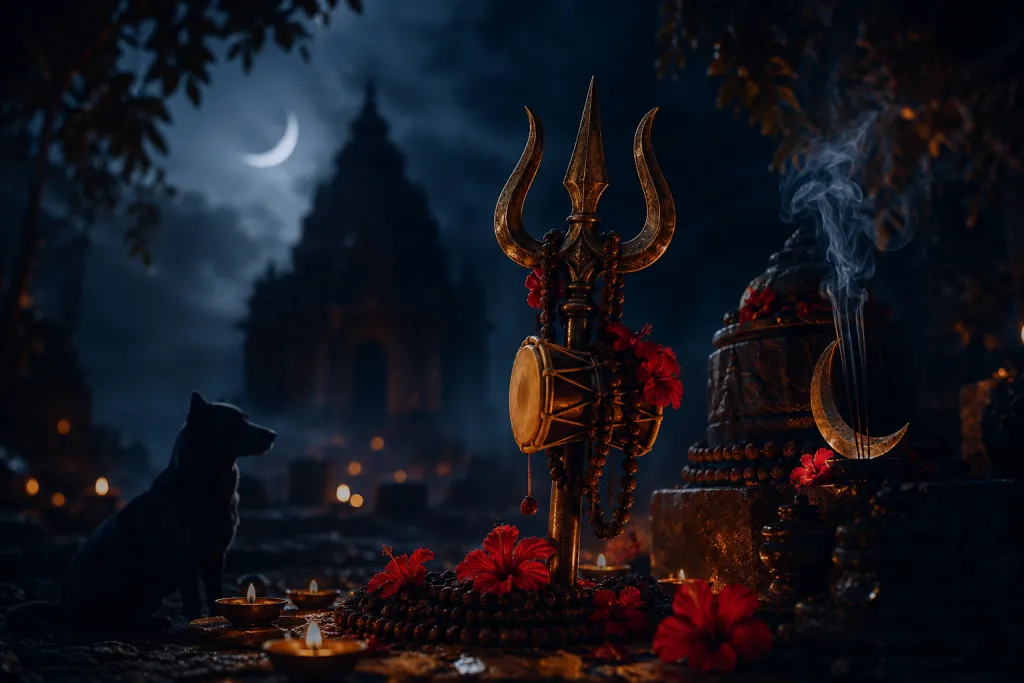
- Offering items associated with this fierce form, such as a lamp lit with mustard or sesame oil, black sesame, and flowers, placed before the deity in the evening.
- Feeding and honouring dogs, which are regarded as the mount (vahana) of Kalabhairava, often with milk, sweets, or food set aside for them.
- Keeping a night vigil with chanting in some temples and households, since the worship of this form is held to be most fitting after dark.
Regional variations
How this date is determined
Observed on the Ashtami tithi of Margashirsha (Krishna paksha), reckoned by midnight (nishita kala).
Dates are computed to astronomical precision (NASA/JPL ephemeris), in line with traditional panchang.