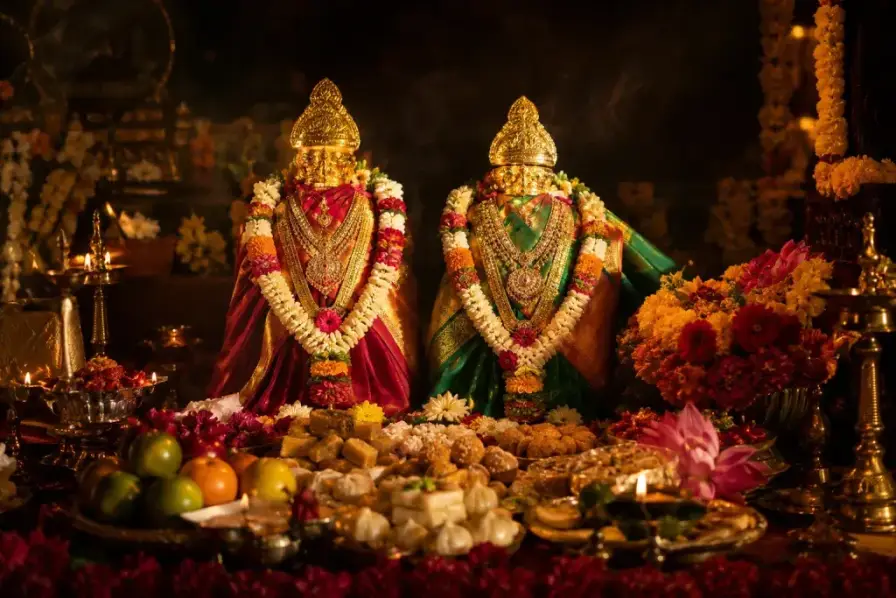
Jyeshtha Gauri Pujan
Goddess Gauri (Mahalakshmi)
When it falls
The date shifts because it tracks the moon, not the Gregorian calendar.
Calculated for India (IST) using precise Panchang astronomy. Dates can shift by a day at locations far to the east or west.
Significance of the worship day
Jyeshtha Gauri Pujan is the heart of the three-day Gauri festival, falling the day after the Gauris are welcomed in at Avahan. Pujan means worship, and on this central day the Gauris, seated and adorned the evening before, receive the full and formal worship of the household. They are understood as Gauri (Parvati), Lord Ganesha's mother, and are honoured together as Mahalakshmi, often as a pair: Jyeshtha (the elder) and Kanishtha (the younger) Gauri.
The day is fixed by the Jyeshtha nakshatra, the second of the three consecutive nakshatras that govern the festival: arrival on Anuradha, this principal worship on Jyeshtha, and farewell on Mula. Because the day follows the nakshatra rather than a tithi, the matching calendar date shifts each year. The richly dressed Gauris are offered a grand naivedya (food offering), classically including sixteen kinds of leafy vegetables (solah bhaji) and puran poli, the sweet flatbread filled with lentils and jaggery.
More than a household rite, the day is one of the most important women's festivals in Maharashtra. Married women (suvasinis) are invited and honoured with haldi-kunku, the gift of turmeric and vermilion exchanged between married women, and the gathering becomes a social occasion as much as a devotional one. Women come together to sing traditional Gauri songs (ovya and aartis), and in many homes a night gathering is kept, before the loving farewell that follows on the third day, Jyeshtha Gauri Visarjan.
Rituals & observance
The worship day brings the household's full puja together with a grand feast and the gathering of married women. Customs vary by family and region, but the core elements recur.
- The main puja: the richly dressed Gauris are formally worshipped at the shrine, often alongside the household Ganpati, with lamps, flowers, and incense.
- A grand naivedya: a festive feast is offered, classically including sixteen kinds of leafy vegetables (solah bhaji) and puran poli, the sweet lentil-and-jaggery flatbread.
- Haldi-kunku for suvasinis: married women (suvasinis) are invited and honoured with haldi-kunku, the gift of turmeric and vermilion shared between them.
- Singing Gauri songs: women gather to sing traditional Gauri songs, the ovya and aartis sung in praise of the goddess on this day.
- Adorning and fresh offerings: the Gauris' sarees, ornaments, and garlands are refreshed for the principal worship, with new flowers and offerings placed before them.
- A night gathering: in many homes a night gathering is kept, with singing and the company of family and invited women, marking the central evening of the festival.
Regional variations
How this date is determined
with the Moon in the 18 nakshatra, reckoned by the afternoon (aparahna).
Dates are computed to astronomical precision (NASA/JPL ephemeris), in line with traditional panchang.